
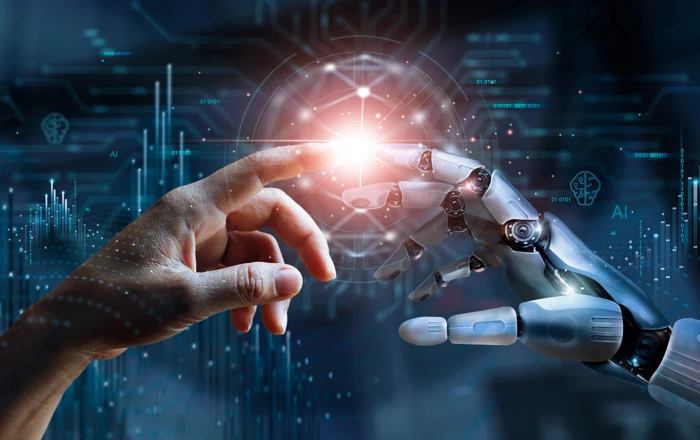
Perceived dangers vs actual benefits
It’s the end of the world, right?
We’re currently living in volatile times, with information overload available at your fingertips. As such, it’s very easy to get lost in the foray of negative news, which currently appears to be a never-ending onslaught.
Surely it can’t all be that bad?
Well, stepping away from the constant coverage of war and the end of humanity, I think it’s important to look at the world through a wider lens. Whilst we can all acknowledge that truly terrible actions are ongoing, we are also living through one of the most exciting technological times in history, period. Taking the yin with the yang, it’s this that I want to focus on today: 10 minutes of freedom from tyranny, giving you a techno-optimist view on all the latest, exciting AI developments and how Ralph Wiggum from The Simpsons is the best illustration of this (without utilising his likeness due to copyright reasons).
Starting point
If the printing press democratised information and the internet democratised access, then AI is quietly but profoundly democratising capability, in a way that is already altering how work gets done on a day-to-day basis.
Previous technological shifts tended to move in waves, often gated behind infrastructure, cost, or specialist knowledge. This one, though, has arrived through our Google Chromes and Apple App Stores and tools like ChatGPT have lowered the barrier to entry to such a degree that it’s almost become an active decision not to use it.
The consequence is that productivity gains are already showing up in codebases, research workflows, marketing pipelines and operational processes. The early innings argument still holds, but it is becoming increasingly difficult to claim that we are waiting for the value to arrive. In many cases, it already has and this is only the beginning! Currently many are utilising AI tools like ChatGPT as the advanced predictive text generation engines that they are, seeking quick, bespoke answers to questions. This alone is of course helping with productivity, but the possibilities in the coming years are profound, exciting and worth exploring.
Which brings us to a slightly unexpected place.
“I’m in danger”
There is a well-known moment in The Simpsons where Ralph Wiggum, with his usual disarming sincerity, looks around and calmly says, “I’m in danger.”
It has become the default reaction image for situations that feel vaguely out of control and it captures the current mood around AI rather neatly. There is a growing sense that something important is happening, but also a lingering uncertainty about what exactly that means and how quickly it might escalate.
The interesting part, is that the real shift is not quite where most people are looking. The narrative tends to focus on perceived intelligence, on whether models are getting smarter, more creative, or more human-like in their responses. In reality, the more important development, in my mind, is far simpler and far more mechanical.
AI is learning to repeat itself.
The loop
At the core of many of the newer systems sits a deceptively simple idea. A model produces an output, evaluates that output, adjusts its approach and tries again. Then it does the same thing again. And again.
This is what we’ll refer to as a loop. It is not glamorous and in its earliest forms it was almost rudimentary. Rather fittingly, these are actually known as ‘Ralph Wiggum loops’, which comes from these initial implementations where systems would simply run the same instruction repeatedly with slight variations, often with mixed results, much like our simple yet persistent friend, Ralph, personified. It was crude and chaotic, but it introduced something critical into the equation which is this idea of persistence.
Once a system is allowed to iterate, it stops being a one-off tool (like a ChatGPT query) and starts behaving more like a process, which is where things begin to accelerate.
From that starting point, a few distinct strands have emerged, built on the same underlying principle but applied in different directions. Research, prediction and action are what I shall cover here.
Self-iteration – Research
On one side sit systems focused on research and knowledge generation. The concept behind Autoresearch, a recent creation from Andrej Karpathy (co-founder of OpenAI), is a good example of how this has evolved.
Instead of asking a model a single question and accepting a single answer, the system continuously refines its own line of inquiry (like the Wiggum loop on steroids).
Autoresearch gathers information, formulates new questions and then feeds answers back into its code, all in the aim of working towards its goal.
This process repeats in five minute increments, with Autoresearch testing, tracking whether it’s getting closer to the goal you’ve set, and, if so, updating its code and iterating from that improved base. If not, it resets and tries again.What you end up with is less a chatbot and more an analyst that never quite stops working. It reads, it synthesises, it tests ideas and then it revisits those ideas with new information and so forth. To put this in perspective, you can run this self-improving AI overnight and it will have had over 100 tests to improve itself and give you better marketing copy, financial strategy, medical research etc. as a result – let alone if you leave it running for weeks on end!

Self-iteration – Prediction
Taking this research piece a bit further, some of the new tools we’re now using when determining the macro environment we’re living in include Polymarket, Kalshi etc. These prediction markets are proving to be an effective way of determining outcomes based on information currently available. Their effectiveness though is obviously constrained by the appeal of the market (i.e. the less people contributing their opinion via bets to a specific market (like, will there be a new Simpsons season before the year is out) means less of a cash pool to win from, which in turn means fewer opinions to determine the likely result of that bet from).
Emerging frameworks like MiroFish (invented by a Chinese student) take this prediction market idea a step further by structuring AI loops in a way that begins to resemble said markets. Thousands of AI agents are spun up at once, contending with information you have provided, all with different personalities programmed in, representing the differing thought patterns and specialisms in participants of prediction markets. Then they quickly ‘have at it’ to generate a likely conclusion to the problem you have presented it, be it a macro piece like the ending of a conflict, to a micro piece like who will win your local by-election (my money is on Count Binface).
In the absence of AI, these micro markets traditionally would have had way fewer participants to draw out a decent conclusion. It would be a stretch to describe this as prediction in the strict statistical sense, but it is not unreasonable to view it as an increasingly effective way of narrowing down the range of plausible outcomes.
The important point is not that these systems are always right. It is that they are getting faster at being less wrong and can be very acutely tailored to your needs.
Ready, set, action
Running parallel to research and prediction is another category, which focuses not on thinking, but on doing.
Frameworks like OpenClaw and Claude Code Scheduling take the same looping structure and connect it to real-world actions, creating AI Agents. Instead of refining an answer, the system refines a sequence of tasks. It might write code, execute that code, observe the result, debug it and then rerun the process. It might interact with APIs, send instructions to other systems, or manage workflows across multiple tools.
These systems are not waiting for instructions at every step. They are given an objective (like drafting a newsletter and sending it on a weekly basis) and they work through the steps required to achieve it, adjusting along the way as needed.
This is where the language around agents begins to make sense. Tools like CrewAI extend this further by allowing multiple agents to operate together, each with a defined role, passing information between one another and coordinating towards a shared goal, becoming an organisation in its own right, with you as the CEO setting the goals, bigger picture and constraints!
These agents of course need a lot of setup and aren’t for absolute beginners, given inherent security and cost risks, but once functioning you can easily imagine having a team that operates at machine speed but without the usual constraints of meetings, calendars, or sleep.
From assistance to autonomy
The natural progression from here is towards agents that can observe, plan, act and reflect without requiring constant intervention.
This is often described as self-driving software, which is not entirely inaccurate. The user sets the objective and the system works out how to get there. There are still limitations and these systems can be brittle, particularly when faced with edge cases, poorly defined goals, or limited, expensive tokens. However, the trajectory is clear, though in an ideal world everyone comes along on this journey as opposed to individuals being split into AIhaves and have-nots. And a part of this is dispelling some of the fear that these quick developments are creating.
Revisiting the concern
The instinctive reaction of “I’m in danger” is understandable. Rapid technological change tends to create discomfort, particularly when it touches on areas that were previously considered uniquely human, like research and action.
However, the more measured view is that this is an amplification of capability rather than a simple replacement dynamic.
Individuals equipped with these tools can operate at a level that previously required teams. Research cycles compress, development timelines shorten and decision-making becomes more data-informed and iterative. The marginal cost of producing high-quality output begins to fall, which has implications across industries.
There are, of course, risks. Systems can be misused, outputs can be flawed and overreliance without understanding can lead to poor decisions. These are not new problems, but they are being accelerated alongside the benefits and need to be considered and addressed accordingly.
Show me the money
From an investment perspective, the immediate beneficiaries are relatively clear.
At the infrastructure layer, companies such as Nvidia and TSMC are central to the production of the hardware that underpins these systems. As demand for compute increases, so too does the importance of those who design and manufacture it.
Networking becomes equally critical, with firms like Arista Networks enabling the movement of vast amounts of data between systems.
At the platform level, companies such as Microsoft are positioned at the intersection of model development and enterprise deployment. The ability to integrate AI into existing workflows at scale is a significant advantage. All of the above companies have a place in the Titan Global Blue Chip Fund.
Beyond this though, the landscape becomes more nuanced. Traditional software models may face pricing pressure as capabilities become commoditised, while new entrants built natively around AI have the potential to operate with structurally lower cost bases at a faster pace and have the potential to be powerful disruptors which we are keeping a keen eye on.
Investing with the same tools
Speaking of Titan Global Blue Chip, these systems are not just shaping the companies we invest in, they are increasingly shaping how we invest.
Research processes can be augmented, data can be analysed more efficiently and patterns can be identified more quickly. The same loops that power all we’ve discussed above can, in a more controlled form, be applied to investment workflows.
In that sense, the industry is beginning to participate in its own flywheel. AI improves research, improved research leads to better decisions and those decisions inform how capital is allocated into the very technologies driving the change.
Closing thoughts
The idea that we are “in danger” captures the uncertainty of the moment and the wider world, but it misses the more important and exciting point.
The defining feature of this cycle is that AI is becoming more iterative, more connected and more embedded into real-world processes. It is already visible in how work is being done, how companies are operating, how value is being created and how the world is moving just as much forward in a positive light as it is moving backwards, throwing missiles at one another.
The compounding nature of AI can be terrifying, but once you start unleashing your inner Ralph by laughing in the face of change and being inquisitive, you start to see the loop and the immense value it can add. And with you remaining in the driving seat, you start to see the amazing places where it could lead.
Be more Ralph.