Could you point Cape Verde out on a map?
As of a month ago, I would hazard many of us could not. But that is one of the many powers of the World Cup, particularly for us British folk: we do love an underdog, and so I would further hazard that many of us now have a newfound affection for the *checks notes* African archipelago.
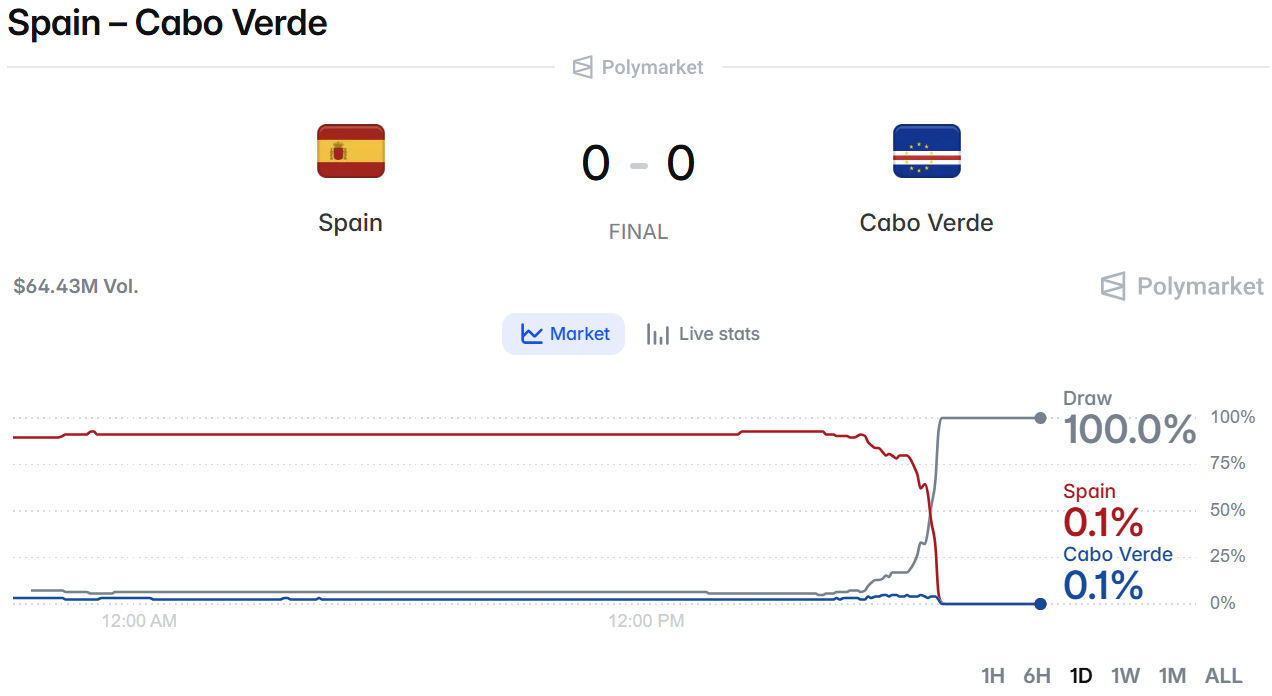
That affection truly came to fruition in the Shakespearean tale of a rich man’s hubris getting the better of him. One Polymarket trader reportedly placed roughly $1 million on Spain to beat Cape Verde, at odds implying around a 92% chance of Spanish victory. The match finished 0-0. Spain was surprised. The world was surprised. Frankly, even Cape Verde’s 40-year-old goalkeeper Vozinha appeared surprised, though he did have the decency to make seven saves, win Man of the Match, and become an overnight social-media phenomenon.
For most of us, this was football theatre, but for prediction markets, it was publicity that money simply cannot buy, unless of course you are the chap who bought “Spain to win” contracts and received nothing but a permanent place in internet folklore.
So, what actually happened behind the curtain?
A prediction market is, in essence, a market for outcomes. Take a simple question: “Will Spain beat Cape Verde?” Instead of a bookmaker offering odds, traders buy and sell contracts linked to possible outcomes. A “Yes” contract priced at 92 cents implies the market thinks there is roughly a 92% probability of that outcome occurring. If Spain win, the contract settles at $1. If Spain do not win, it settles at zero, with the 92 cents you paid going to cover the party that bought the other side of the contract, i.e. the “No” contract of “Will Spain beat Cape Verde?”. It is elegantly brutal.
On-chain platforms such as Polymarket add another layer. The contracts, trades and settlement mechanics can be recorded on a public blockchain ledger. In plain English: rather than taking the platform’s word for it, observers can often see the flows, wallets, positions and settlement activity directly. That transparency is part of the appeal. It is also why a large, failed trade can become a public spectacle – rather as we’ve seen above.
At the back end, the market itself usually works in one of two ways. The first is a central limit order book, or CLOB, which is the familiar exchange model we all use on a daily basis in equity markets. Buyers and sellers post the prices at which they are willing to trade, and the platform matches them when those prices meet. The second is an automated market maker model, often using something called logarithmic market scoring rule, LMSR, where an algorithm continuously adjusts prices based on the flow of buying and selling. In both cases, the important distinction is that these platforms are not supposed to be acting like traditional gambling firms setting odds as “the house”. They are closer to financial exchanges where the market participants set or move the prices, and the platform monetises the activity through trading volume, fees, spreads or related infrastructure.
The academic version of prediction markets is fairly noble. Prices aggregate dispersed information, so if thousands of people, each with a different sliver of knowledge, are willing to risk real money, then the resulting price can become a useful real-time probability estimate. During the 2024 US presidential election, Polymarket’s main presidential winner market attracted around $3.7 billion of trading volume, making it one of the most visible examples of market-based forecasting breaking into the mainstream, and given the volume that accrued it was actually a more accurate predictor than many of the polls themselves.
And the World Cup has accelerated the trend. It’s estimated that tens of billions have already been traded on the 2026 World Cup across Polymarket and US-regulated Kalshi. This is certainly no longer a niche corner of crypto, but rather it is becoming a mass-market financial product akin to standard gambling itself.
The potential uses go well beyond sport. Weather contracts could help businesses hedge against heatwaves, rainfall or snowfall. Agricultural contracts could, in theory, help farmers manage exposure to crop prices or weather outcomes. Kalshi has expanded into commodity-linked event contracts, including agricultural markets such as corn, soybeans, wheat and cattle, while weather markets can settle against official data such as National Weather Service reports. Used properly, prediction markets can be instruments of price discovery, risk transfer and information aggregation.
Used less properly, they can become straight-up gambling with an elegant financial overtone disguising the fact they should probably just be regulated like gambling companies.
The Commodity Futures Trading Commission fined Polymarket $1.4 million in 2022 for operating unregistered event-based binary options markets, while US platforms such as Kalshi argue that regulated event contracts belong within the federal derivatives framework rather than state gambling regimes. Either way though, the age of the prediction market is certainly here, and here to stay.
Whilst we all love Cape Verde, all fairy tales have to end (though admittedly in dramatic fashion with a narrow loss to Argentina, despite an absolute worldie of a goal), and the Spains of this world usually show their true grandeur and eventually pull through (unless of course Ronaldo has anything to say about that this evening, with Portugal currently having winning odds of 23% on Polymarket). That is why, for all the privately listed upstarts like Polymarket and Kalshi, it is the publicly listed new-financial-world apps like IBKR and Coinbase that capture our attention and that we, as managers of the Titan Global Blue Chip Fund, follow very closely.
P.S. It’s coming home.