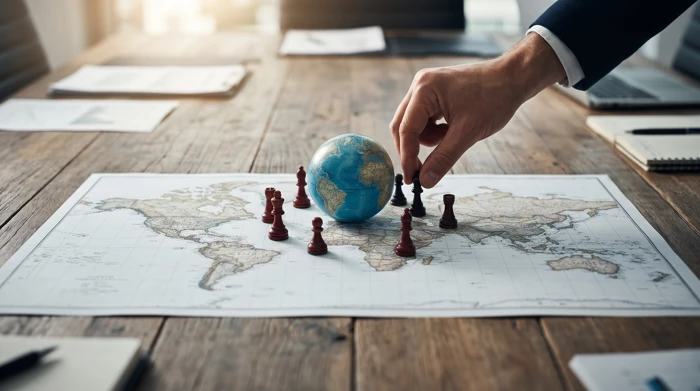
While “Building an Asia-Pacific Community to Prosper Together” was the theme and priority for the 34th Asia-Pacific Economic Cooperation (“APEC”) summit held last week, the meeting between presidents Donald Trump, Vladimir Putin and Xi Jinping may have taken centre stage, along with other side-line diplomacy.
However, what caught my eye was Trump’s stopover in the Philippines, where President Ferdinand Marcos Jr. arranged for fried chicken from Filipino fast food chain Jollibee to be delivered to the US delegation as a late-night snack. This got me pondering the differences between the three very different world leaders and their agendas for the summit, not least because the US president is apparently partial to McDonalds, KFC, pizza and Diet Coke (although I am sure the dietary requirements for of Presidents Putin and Xi are more of a closely kept secret).
The three leaders met at the summit in Shenzhen, which brought together 21 members representing around 2.7 billion people – more than 40% of the world’s population and around 60% of global gross domestic product (GDP).
China, Russia and the US are the three largest members of APEC, although its membership includes a broad spread of smaller and, what might be considered, emerging market countries. Leaders meet annually, primarily to encourage and promote free trade and multilateralism while reducing trade and investment barriers. However, the ‘elephant in the room’ could be Donald Trump’s recent tariff drive, which has instead resulted in a rise of nationalism and protectionism.
For investors, tariffs and other barriers to trade can influence supply chains, corporate costs and inflation, while uncertainty over trade policy can quickly feed through to currencies and equity markets. Shifts in policy between the world’s largest economies can therefore have consequences well beyond the negotiating table.
It had been widely reported that the meeting of the three leaders might distract from the main purpose of the summit, with global security, the war in Ukraine, tensions involving Iran and the latest developments surrounding the sale and export of advanced microchips from the US to China taking centre stage. This is particularly relevant given reports of potential tougher chip export rules on the cards.
Indeed, the meeting of the three world leaders was unprecedented, with Putin, Xi and Trump holding their first formal trilateral meeting together. The three leaders subsequently issued a joint statement focused on peace and security, pledging dialogue on nuclear risk reduction, increasing oil supplies, pursuing UN reforms, and opposing the International Criminal Court. The meeting produced no new nuclear arms control treaty or concrete resolutions on major conflicts, and the joint statement made no mention of the wars in Ukraine or Iran.
Whatever the long-term significance of the meeting, this distinction between symbolism and substance is perhaps the important one for investors. Markets can react quickly to geopolitical headlines, but, ultimately, it is changes to policy, trade, sanctions, energy supplies and corporate earnings that tend to have more lasting economic consequences.
Our investment process also looks beyond technology to the broader emerging markets and, in particular, their domestic economies, the rise of the emerging market middle classes and their increasing contribution to global consumption. The investment case for emerging markets is not simply a bet on semiconductors or AI. It also reflects longer-term structural changes taking place within these economies as incomes rise, domestic consumption grows and businesses become less reliant on demand from developed markets.
Many emerging market economies offer the potential for faster economic growth and, on average, lower government debt relative to GDP. Their stock markets can also offer greater diversification and attractive valuations. As these economies develop, their countries and companies could continue to form a larger part of global stock markets and investment portfolios.
To end on a more light-hearted note, and on the subject of global leaders past and present, it has been said that our very own Margaret Thatcher ate more healthily, always insisting on doing her own cooking, with eggs featuring heavily!