

“And you may ask yourself, well, how did I get here?”
Talking Heads, Once in a Lifetime (1980)
This is a question investors could reasonably have asked themselves at the end of September.
Only a few years ago, interest rates were close to zero, bond yields were at historic lows and energy was cheap. Cheap money, it turns out, was a phase rather than a law of nature. Today, long-term UK and US government bond yields are above 5%, energy is once again feeding inflation and governments are wrestling with the cost of servicing debts that were run up when borrowing was almost free. At the same time, the US and China are locked in a technological arms race that demands enormous investment in computing power, energy and infrastructure.
The investment landscape has changed, and the third quarter provided plenty of evidence. Andy Burnham entered Number 10, the Federal Reserve raised interest rates and energy prices moved sharply higher. Most significantly, long-term bond yields kept rising as markets weighed resilient growth, persistent inflation and increasingly uncomfortable levels of government borrowing.
Against this backdrop, our portfolios have made good progress. Year-to-date, Income has returned 2.6% (1), Higher Income 5% (2), Balanced 7.4% (3) and Growth 10.3% (4), while Global Blue Chip returned 12.9% (5) and Global Solutions 13.4% (6).
These returns compare favourably with our peer group benchmarks. Current estimates show ARC Cautious at 2.5%, ARC Balanced 5.6%, ARC Steady Growth 7.3% and ARC Equity Risk 9.2% (7). Investors willing to take more equity risk have been well rewarded, while our lower-risk strategies have continued to make positive progress.
Bond markets were the defining story of the quarter, and not only in Britain and America. Yields in Japan, France and Germany also reached multi-year highs. Rising yields matter well beyond fixed income. They raise government financing costs, give equities serious competition and have taken some of the shine off gold. The new Chancellor presents his first Budget on 28th October, and the gilt market has shown that it marks these exams strictly. The price of money matters again.
There is, however, more than one way to read the rise in yields. Higher real yields may partly reflect optimism about growth and productivity as investment in artificial intelligence accelerates. That is potentially very positive, but it makes valuation more important, not less. Even great companies and powerful themes can disappoint if too much future success is already in the price. Our conviction in the long-term themes therefore remains, as does our commitment to diversification.
AI also links the two stories. It is often discussed as though it lives entirely in the cloud, but it has an enormous physical footprint. Data centres need vast amounts of electricity, which means new generation, transmission and grid infrastructure. Grids need copper, while chip-making needs energy, water and ever more sophisticated supply chains. Increasingly, this extraordinary investment is also reaching the bond market, as the largest technology companies become significant issuers of debt. The constraints can themselves become investment opportunities.
The world is also fragmenting, and politics will stay firmly on the agenda. America’s midterm elections in November are likely to bring noise and probably some volatility, and President Trump knows exactly what petrol prices do to voters. How he tries to bring them down – domestic production, strategic reserves, pressure on producers or foreign policy – remains to be seen.
Predicting these short-term movements is difficult, but, fortunately, we don’t need to. Our approach remains to look past the noise to the structural changes beneath it: a more fragmented world, greater investment in defence and energy security, a technological arms race now reaching into space and rising demand for the infrastructure and resources needed to support it all. There will be bumps along the way. Our job is to stay diversified, own high-quality assets and keep portfolios positioned for these longer-term trends.
As for how we got here: patience, diversification and an unwillingness to let short-term headlines distract us from the longer-term picture. So far in 2026, that approach has served our investors well.
Market Update
By Alex Finer
The third quarter was somewhat of a tightrope walk, with thin margins for error around earnings reports, central bank decisions and heightened geopolitical and macroeconomic tensions.
The direction of travel was clear. More than 80% of developed-market central banks raised policy rates, the US administration announced a new wave of trade tariffs and oil rose from around $73 at the start of the quarter to just shy of $100 at quarter end, with sharp swings in between.
July was the weakest month for overall market performance, with concerns over the extent of AI spending triggering a semiconductor sell-off and Middle East escalation pushing Brent above $100, while the Federal Reserve (“Fed”) held rates with three members dissenting in favour of a hike.
Equities recovered in August on blockbuster results from Microsoft, Amazon, Palantir and Nvidia. Energy kept climbing, while consumer staples and discretionary companies struggled. Rate-sensitive areas such as small caps, utilities and real estate lagged as yields climbed. September then brought a pivotal shift in policy, as war-driven energy inflation ended the “rates on hold” narrative: the Fed delivered its first hike since 2023, the European Central Bank (“ECB”) and Bank of Japan also raised rates, and the 10-year US Treasury yield pushed above 5% for the first time in almost two decades.
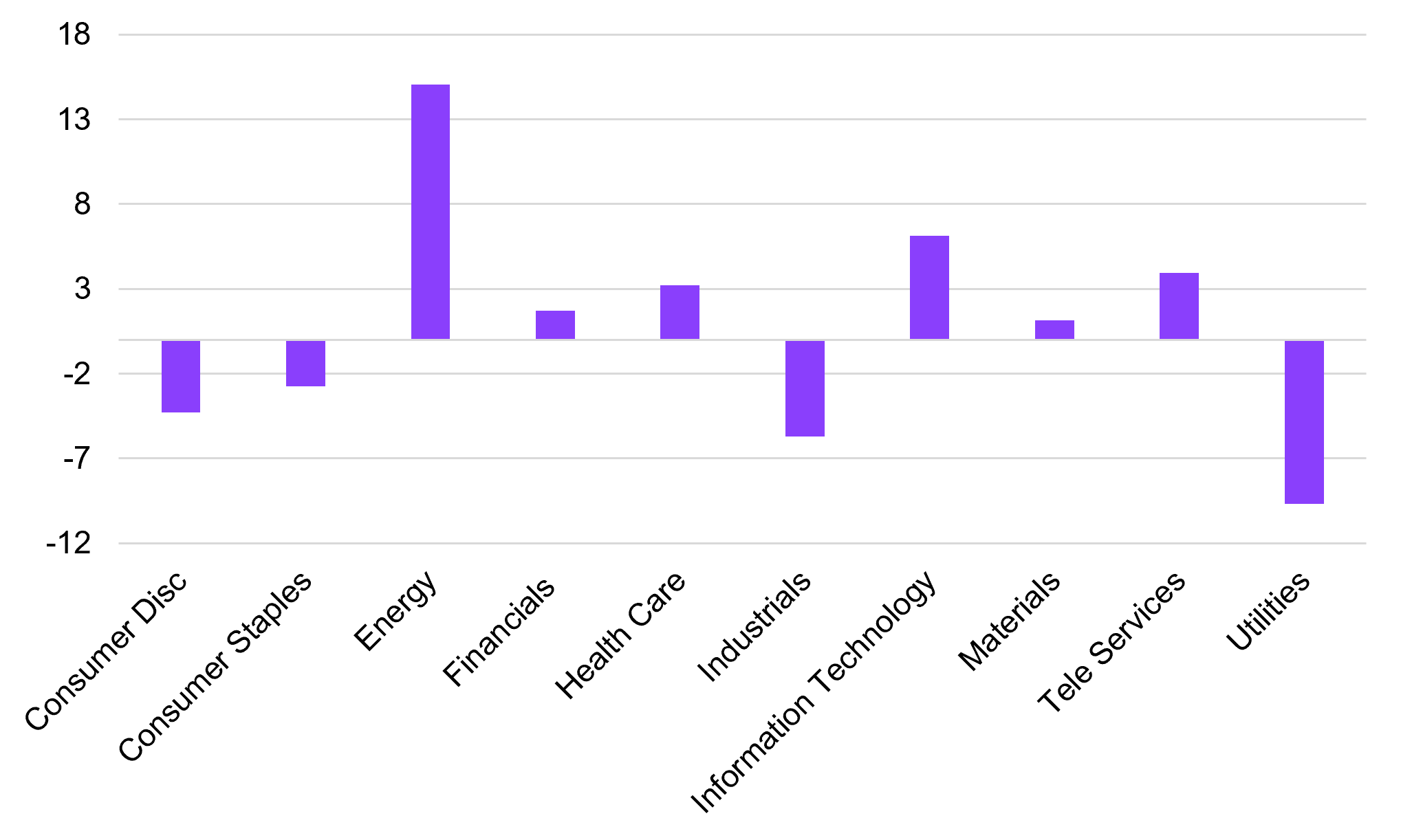
A notable development was the divergence between bond and equity markets. Equity investors appeared relatively unfazed by the concerns that drove a global bond sell-off, including persistent inflation, rising fiscal deficits, higher government borrowing and expectations that central banks may need to keep policy restrictive. Global equities reflected confidence in an economic backdrop that remained more resilient than many had anticipated, advancing 1.8% (8) over the quarter while global aggregate bonds, hedged to sterling, fell -2.6% (9).
Regionally, Japan led, supported by the strength of its AI and semiconductor supply chain and a firmer yen, with the US and UK following. Emerging markets slipped, recovering from a sharp late-July sell-off, while Europe lagged as higher yields and ECB tightening weighed on a region exposed to energy-driven inflation.
Global bond markets faced a challenging quarter as the ongoing US-Iran conflict pushed energy prices sharply higher, reigniting inflation concerns and lifting government bond yields. Concerns were most visible in France, where contagion fears grew as the spread over German Bunds reached its widest since the 2012 euro crisis, with the French 10-year yield close to 5% – its highest since 2002.
Heading into the final quarter, we, along with the rest of the market, are watching bond yields closely. Higher yields have the potential to turn equity sentiment sour, yet so far AI momentum and resilient earnings have been enough to look through them. The question is whether equities are right to do so, or whether bond markets are the better guide.
Multi-Manager/Asset Strategies
By Bob Tannahill
Taking a step back from the short-term headlines, it is becoming increasingly clear, in our view, that the past five years have marked a regime shift in markets. The twin shocks of the pandemic and the Russian invasion of Ukraine shattered the peace of the world of superficially benign globalisation that we had all known for several decades. As the dust settles on this new world, a new set of challenges faces investors. The old world of capital-light businesses driving markets and the key risk being slow growth, which could be hedged by government bonds, is gone. We are in a very different world today.
It is a world of massive capital expenditure programmes, from rearmament to energy transition, to artificial intelligence to reshoring and reindustrialisation. These programmes create big profits for those corporates that stand to benefit, and we have seen a major rise in corporate profits in 2026. This has driven a gap in public perception between strong equity markets and endlessly gloomy headlines. The benefits of this profit cycle are increasingly accruing to capital-intensive businesses outside the US, in contrast to the previous era that was so dominated by capital-light tech businesses. Just as the beneficiaries have changed, so have the risks. Today the risks of asset bubbles, entrenched inflation, capex slowdowns and fiscal crises loom large.
In this new world, both how investors capture the gains and how they protect against the risks are different. On the upside, investors need exposure to the capex beneficiaries, and AI capex is at the heart of this – although it is not the only game in town. On the downside investors face a set of risks, the spread of which complicates the task of building resilience into portfolios.
In our multi-manager portfolios, particularly Balanced and Growth, we have been focusing on our equity mix over the summer. Over the last two years we have broadened the geographic spread of our equities and, more recently, we have been fine-tuning our exposure to the AI build-out. The AI theme has spread from core positions such as Polar Artificial Intelligence (“AI”) to adjacent areas such as Asia and Japan. We saw in July how hard this complex can fall when investors get spooked and we continue to work to carefully size, diversify and counterbalance it. We trimmed Polar Asian Stars in July and used the rebound in August to trim Polar AI. Both funds were sat on large gains and so we were happy to take some profits. We had also observed that areas like healthcare equities were starting to rally in AI sell-offs, which is helpful in portfolio construction. We are using positions like these, and more value-orientated or defensive equities, to balance out our AI-related exposures and remain diversified.
Beyond that, we are considering how we protect against the inflationary risks. We have long been cautious around long-dated government bonds and the recent stresses in French government bonds have further entrenched our view that material risks exist there. Finding positions, however, that thrive, as opposed to simply survive, in inflationary periods is a challenge due to the volatility and cyclicality of commodity exposures. Someone once said that if you think a decision is binary you haven’t looked hard enough. I firmly subscribe to this view, and we continue to work hard to try and find ways to build more inflation defence into portfolios without having to take binary bets on commodity prices.
Please find performance commentary on our core multi-manager strategies below; Cautious, Higher Income, Balanced, Growth and Global Solutions, followed by our direct equity approach, Global Blue Chip. Each strategy is available via a segregated investment portfolio or via our Titan Global Fund Range.
If you would like to discuss any of our investment solutions further, please don’t hesitate to get in touch with a member of the team.
Cautious Portfolios
Lower Risk
A volatile month for risk assets concluded an otherwise challenging quarter for investors having to navigate choppy market returns. Against this backdrop our Cautious portfolios fell 0.3% (10) across the quarter, but maintain their year-to-date outperformance, up 3.1% (11) as at the end of September, versus the benchmark’s 2.5% (12).
It was a difficult quarter for fixed income markets, where current geopolitical conflicts continue to put upward pressure on inflationary conditions. This has resulted in global central banks taking a hawkish stance on monetary policy. In September, the ECB raised the deposit rate by 0.25%. The Fed then followed suit, raising rates by 0.25% and the Bank of Japan adding 0.25% to 1.25%. The UK, however, bucked the trend and left rates unchanged. Nevertheless, the market is currently pricing in a hike at the Bank of England’s next meeting in November.
There were wide dispersions within equity market returns depending on sector and/or geographic exposure, though, broadly speaking, equities performed better over the quarter. The three top performing fund holdings over the period were all equity allocations. The Prusik Asian Equity Income Fund was the top performer, returning 2.7%, while two global equity income positions, the Guinness Global Equity Income and NinetyOne Global Quality Dividend Funds, both gained 1.4%. At the other end of the spectrum, the KBI Global Sustainable Infrastructure Fund was down 6.1%.
The portfolio’s fixed income allocations were largely negative across the quarter, notwithstanding the fund’s allocation to the iShares £ UltraShort ETF (+1.0%) and the flat return from the Royal London Short Duration High Yield Bond Fund. The Muzinich EM Short Duration Fund (-0.3%) rounded out the top three performers, underlining the impact a preference toward lower-duration fixed income vehicles is having on the portfolio’s bond allocations. The Titan Core Credit Fund was the worst performer, falling 2.6%.
Moreover, the fund’s ‘diversifying assets’ bucket provided for good uncorrelated risk-adjusted returns. The Vontobel TwentyFour Asset Backed Securities Fund gained 1.2%, while a positive return for the Ruffer Total Return Fund (+0.6%) was also helpful. Fermat was the outlier, falling 0.6%.
Higher Income Portfolios
Medium Risk
The Higher Income Fund returned 0.3% (13) in total return terms, including capital and income returns, over the third quarter. The fund remains slightly up in capital terms year-to-date, at +0.8% (14), and continues to be on track to deliver an income yield ahead of cash rates.
The period saw investors finally focus on a long-running trend: rising long-term government bond yields. The yield on the benchmark 10-year UK government bond has climbed from below 0.25% during Covid to more than 5.25% today. While these higher yields offer far more attractive return prospects for new investors, they create growing challenges for heavily indebted Western governments.
Debt accumulated through successive crises, from the 2008 financial crash to recent energy support measures, was manageable when interest rates were near zero. As yields rise, however, debt-servicing costs increase sharply. In the UK, annual interest payments on national debt have risen from around £40 billion p.a. in 2020 to over £100 billion today.
Higher financing costs restrict governments’ ability to support economic growth and raise the risk of market disruptions, similar to those seen during the Truss administration. By the end of September, these concerns were beginning to unsettle bond markets, with government bond yields reaching multi-decade highs and prices falling.
Market performance was mixed, highlighting the value of the portfolio’s broad diversification. The weakest areas were bonds, with Titan Core Credit falling -2.6%, and Candriam down -2.2%. The strongest performers were Schroder Dividend Maximiser on the equity side (+4.9%) and Sequoia on the investment trust side (+3.0%).
These results were in line with our expectations, with the Core Credit fund falling broadly in line with its peer group and strength in equities reflecting the wider market conditions.
Over the quarter we made one change and added a second fund to our emerging market (“EM”) bond allocation. We reduced Muzinich’s conservative EM short duration in favour of M&G’s broader EM Bond Fund. The latter brings EM government and local currency debt into the mix, which adds additional income to the portfolio at the price of a bit more short-term volatility. Given the favourable debt and monetary policy positions of the emerging world today, we believe this is a trade-off that should reward investors in time.
In an uncertain world, we have stress tested the portfolio and remain comfortable with the positioning today.
Balanced Portfolios
Medium Risk
Our Balanced portfolios returned -0.4% (15), slightly behind international peer groups, which posted 0.6% (16) over the period. This takes the year-to-date returns to 7.4% (17) and 4.6% (18) respectively.
Overall, while global share markets continued to demonstrate resilience, rising bond yields, renewed inflation concerns and heightened geopolitical tensions contributed to greater volatility across asset classes. Positive contributions from global equities, Japan and selected alternative strategies were offset by weakness within technology, healthcare, infrastructure and fixed income holdings.
The strongest performer during the period was the Jupiter Japan Select Fund, which returned 7.2%. Japanese equities continued to benefit from improving corporate governance, attractive valuations and resilient earnings growth. The portfolio’s allocation to iShares MSCI Japan ETF also contributed positively, gaining 5.8%, reinforcing the benefits of maintaining exposure to a market that has remained relatively insulated from some of the challenges facing Western economies.
Alternative income and diversifying strategies also performed well. Fermat UCITS Cat Bond returned 4.1%, benefiting from its low correlation to traditional equity and bond markets. The portfolio’s core equity allocations, including the Titan Global Blue Chip and Vanguard Global Stock Index, also delivered positive returns, reflecting ongoing strength within global equity markets.
The most significant detractor was Polar Capital Artificial Intelligence, which declined -10.1%. Following substantial gains earlier in the year, portions of the AI and semiconductor sector experienced a period of consolidation in July as investors took profits and reassessed growth expectations against a backdrop of higher interest rates. Healthcare-related holdings also faced headwinds, with Polar Capital Biotechnology falling 7.7% and Polar Capital Global Healthcare Select declining 0.6%.
Infrastructure and credit markets were similarly challenged. Atlas Global Infrastructure returned -8.5%, as higher bond yields continued to place pressure on infrastructure valuations. Within fixed income, returns were generally subdued, as bonds faced a difficult quarter as inflation concerns, elevated government borrowing and continued policy uncertainty resulted in rising yields across many major markets.
Looking ahead, we remain constructive on the medium-term outlook. Corporate earnings growth remains broadly supportive, labour markets continue to be resilient and investment in AI, automation and digital infrastructure continues to underpin global growth prospects. However, markets are likely to remain sensitive to developments surrounding inflation, interest rate expectations and geopolitical events.
Growth Portfolios
Higher Risk
Our Growth portfolios returned -1.0% (19), behind international peer groups, which posted 0.9% (20) over the period. This takes the year-to-date returns to 10.2% (21) and 7.3% (22) respectively.
The third quarter of 2026 was defined by uncertainty and the fine margins around major economic and rate events, as markets repeatedly judged how much good news was already priced in. July was the weakest month, with AI spending concerns triggering a semiconductor sell-off and Middle East escalation pushing Brent above $100, while the Fed held rates with three members dissenting in favour of a hike. Equities recovered in August on blockbuster results from Microsoft, Amazon, Palantir and Nvidia.
September then brought a pivotal shift in policy, as war-driven energy inflation ended the “rates on hold” narrative: the Fed delivered its first hike since 2023, the ECB and Bank of Japan also raised rates, and the 10-year US Treasury yield pushed above 5% for the first time in almost two decades.
Regional returns diverged. Japan led, up 5.9% in sterling terms, supported by its AI and semiconductor supply chain and a firmer yen. The US and UK also contributed, with UK markets reaching record highs in July and August before fading as gilt yields rose.
Jupiter UK Alpha was up 5.6% over the quarter, well ahead of the UK markets. Fermat Cat Bond returned 4%, uncorrelated to the swings in equities and rates, while Titan Global Blue Chip added 3.1% as strong big tech results reignited the AI trade.
On the downside, thematic and rate-sensitive exposure lagged. Regnan Global Mobility and Logistics fell 11% as its supply chain and transport holdings found little support amid higher oil prices and yields. Polar Capital Artificial Intelligence fell 10.1%, mostly in July’s semiconductor sell-off, while ATLAS Global Infrastructure fell 8.5% as rising bond yields weighed on long-duration assets, and Polar Capital Biotechnology declined 7.7%, giving back recent gains in September.
Despite a turbulent quarter, with falls in AI funds and lags in Europe and emerging markets, it is important to take a wider look at the year. Year-to-date, the strategy is ahead of peers, helped by our regional positioning and our AI exposure.
Global Solutions Portfolios
Higher Risk
Our Global Solutions portfolios returned -4.5% (23), behind international peer groups, which posted 1.5% (24) over the period. Year-to-date returns remain ahead of peers, at 14% (25) and 9.2% (26) respectively.
The third quarter was characterised by a resilient global economy navigating a challenging backdrop of higher energy prices, persistent inflation and elevated geopolitical tensions. Despite concerns surrounding rising bond yields and renewed conflict in the Middle East, global equity markets continued to advance, supported by robust corporate earnings and ongoing investment in AI, digital infrastructure and productivity-enhancing technologies.
Against this backdrop, performance across the Global Solutions portfolio was mixed. While a handful of holdings generated positive returns, many of the portfolio’s longer-term sustainability and thematic strategies experienced a period of consolidation following the exceptionally strong returns seen in previous quarters.
The strongest contributor during the quarter was Wellington Global Stewards, returning 4.6%, reflecting investor preference for high-quality businesses with durable earnings and strong balance sheets. Candriam Equities Oncology also delivered a positive return of 3.8%, benefiting from renewed interest in healthcare innovation and defensive growth sectors. The portfolio’s broad developed market allocation, Vanguard ESG Developed World All Cap Equity Index, added 1.5%, supported by continued strength in global equities despite a more challenging macroeconomic environment.
The principal detractors were concentrated within the portfolio’s resource scarcity, energy transition and AI themes. Polar Capital Smart Energy was the weakest performer, declining 12%, as investors reassessed growth expectations across clean energy supply chains amid higher interest rates. Robeco Smart Materials also experienced a challenging quarter, falling 11.3%, while Regnan Global Mobility and Logistics declined 11%. The portfolio’s AI exposure, Polar Capital Artificial Intelligence, fell 10.1% as some of the market’s most strongly performing AI-related companies experienced a period of profit-taking following substantial gains in recent quarters.
The infrastructure and climate-related allocations also faced headwinds. Nordea Global Climate Transition Engagement, Atlas Global Infrastructure and NinetyOne Global Environment returned -8.9%, -8.5% and -7.1% respectively, reflecting the pressure that higher bond yields can place on longer-duration growth and infrastructure assets.
Looking ahead, the portfolio remains positioned around several powerful long-term structural themes, including AI, resource efficiency, environmental solutions and sustainable infrastructure. While rising interest rates and geopolitical uncertainty may continue to create periods of market volatility, the underlying drivers of these themes remain intact.
Global Blue Chip Portfolios
Equity Risk
By Ben Byrom
Global Blue Chip returned 3.1% in sterling terms during Q3 2026, compared with 1.4% for the benchmark, generating approximately 1.7% relative outperformance. On a year-to-date basis, the benchmark is up 14.3%, around 1% ahead of Global Blue Chip at 13.3%. Given the portfolio’s more explicit thematic exposures, we regard this as respectable and it positions us well for Q4.
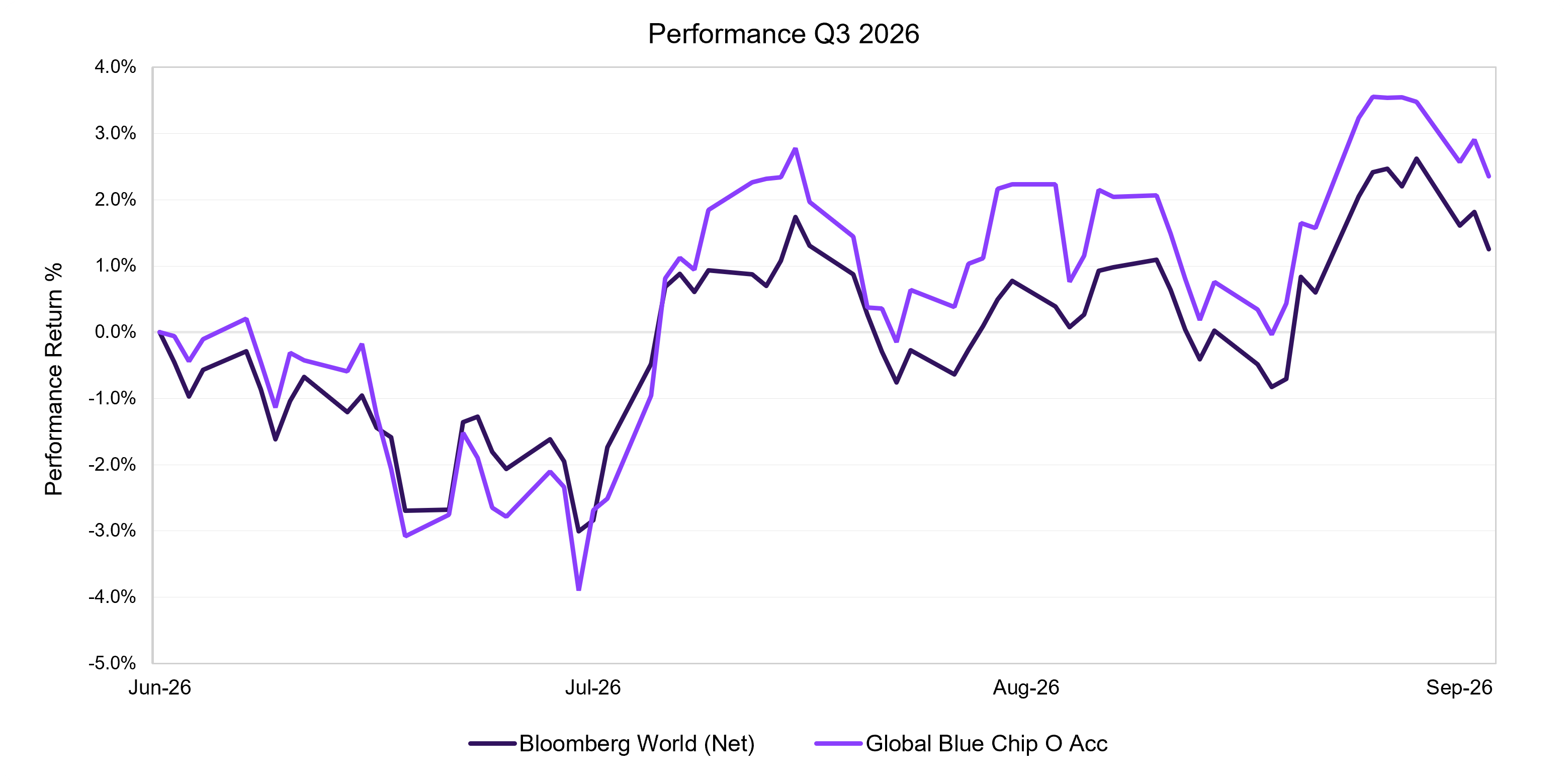
In many respects, Q3 resembled the first half of the year: relatively calm index-level returns masking considerable volatility beneath the surface. Dispersion remained the dominant regime, with capital rotating quickly between sectors and themes, often amplified by leverage.
For example, investors had to contend with a major liquidation event through much of July across the AI complex that wiped out billions of leveraged exposure. It triggered a sharp rotation out of semiconductors and memory into software and internet names. Once the selling pressure had abated in late July/early August, the complex recovered sharply as Q2 earnings released during the quarter provided important information on AI adoption progress, showing that AI investment was beginning to translate into stronger cloud revenues, software monetisation and sustained demand for compute.
As a result, technology was the dominant source of return during the quarter. Exposure increased materially, partly through performance and partly through portfolio activity. July’s forced deleveraging punished semiconductor and AI infrastructure names, but the rotation out favoured software and internet companies where monetisation was becoming more visible. Microsoft, Palantir, ServiceNow, CrowdStrike and Shopify were among the strongest contributors, while KLA, Infineon and ASML were caught in the earlier sell-off. We also broadened our exposure through Apple and, following the sell-off, added AMD, Micron and GE Vernova. Our preference remains to own multiple layers of the AI value chain rather than rely on a single part of the trade.
Diversification elsewhere also helped as the Middle East remained contested, keeping oil prices and inflation expectations elevated. Materials contributed positively, led by gold equities, while energy added to returns through ExxonMobil. We reduced both exposures during the quarter as part of portfolio rebalancing but remain constructive on their medium-term role. Gold continues to benefit from central-bank diversification and fiscal uncertainty, while oil and gas retain strategic value amid geopolitical disruption, rising AI-related power demand and continued consumption growth across emerging economies.
Investors balanced strong economic growth, heavy AI-related investment, fiscal concerns and uncertainty over the future path of rates. In September, Kevin Warsh delivered his first rate hike as Federal Reserve Chair in an effort to reinforce monetary credibility, while conflicting economic data continued to support the idea of a K-shaped economy. The net result was a continued rise in government bond yields across G7 markets.
We are of the mind that bond yields are reflecting a higher rate of economic growth driven by investment and increasingly AI-supported productivity. Amid this environment, we believe large banks should remain central to facilitating the financing of enormous capital requirements associated with AI, energy, defence and reindustrialisation. As a result, the portfolio became more balanced when we increased financials through the reintroduction of Visa following progress around OpenUSD, allaying stablecoin disruption fears, and later when we increased our banking exposure to reduce a long-standing underweight. Elsewhere, Amazon and Meta were supportive, with Meta’s launch of Muse helping provide a more tangible route towards monetising its AI investment.
Healthcare and industrials were the principal offsets. UnitedHealth and Novo Nordisk weakened despite some evidence of improving fundamentals, while Caterpillar was affected by the broader de-rating of capital-intensive and AI-adjacent exposures. We also sold L3Harris after company-specific leadership disruption coincided with weaker defence-sector valuations. By contrast, GE Vernova was added as a direct expression of the growing power requirements associated with AI infrastructure.
Looking forward, we remain constructively bullish but not complacent. Higher borrowing costs, geopolitical risks, a strong dollar and pressure on lower-income consumers remain credible headwinds, while the scale of AI investment raises legitimate concerns around overcapacity, funding requirements and technological obsolescence.
However, in our opinion, the market is already heavily focused on what could go wrong. Economic activity has remained resilient, household wealth and cash balances remain substantial and higher interest income continues to support parts of the consumer base. AI demand is still absorbing new capacity, while competitive pressure on companies and governments to keep investing remains intense. The expansion of AI into agents, robotics and autonomous systems broadens the opportunity set further.
Our conclusion is that the “pain trade” may still be higher. Markets do not need perfect conditions to advance; they need outcomes that are better than those already reflected in positioning and expectations. We therefore enter Q4 constructive, focused on businesses where structural growth is translating into measurable revenues, cash generation or scarcity value, while retaining enough flexibility to act when volatility creates attractive opportunities.
Stock in Focus
Waverton European Capital Growth Fund
by Jake Robin
Despite the dominance of US technology stocks in recent years, investment opportunities have not been confined to a single region or sector. As capital flowed towards a narrow group of market leaders, many European companies with strong competitive positions, improving profitability and attractive valuations received far less attention than their underlying fundamentals arguably warranted. We seek exposure to these returns via the Waverton European Capital Growth Fund.
Much of today’s market commentary remains focused on technology and the beneficiaries of the AI revolution. Waverton takes a differentiated approach by looking beyond these established market leaders for businesses undergoing structural change. Its portfolio, therefore, has substantial exposure to sectors such as industrials, healthcare and consumer discretionary, amongst others, where the managers see improving fundamentals that have yet to be fully recognised by the market.
Waverton’s investment universe is vast, beginning with approximately 10,000 listed European companies before being narrowed through a rigorous screening and research process. From this universe, the managers identify around 170 businesses that meet their quality criteria, maintain a watchlist of roughly 60 names and ultimately construct a concentrated portfolio of just 30-40 high-conviction holdings. Rather than investing according to benchmark weightings, Waverton takes a benchmark-agnostic approach, focusing on companies where improving industry dynamics, earnings visibility and shareholder returns have yet to be fully recognised by the market.
The portfolio is built around two broad categories of investment: “steady growers”, businesses already exhibiting attractive quality characteristics, and “margin improvers”, companies expected to benefit from structural change and improving profitability. This results in a portfolio that differs markedly from traditional European equity funds, with significant exposure to industrials, materials, healthcare and financial infrastructure businesses, whilst maintaining very limited exposure to the technology sector that has dominated recent market performance.
The increasing divergence in regional growth, inflation and earnings trends has reinforced our conviction in dedicated regional allocations. Although the US continues to benefit from powerful structural growth drivers, Waverton European Capital Growth gives us targeted access to a differentiated portfolio of European businesses. The allocation complements our existing global and US-focused holdings by broadening the portfolio’s regional and sector exposure, while capturing opportunities arising from structural change, improving returns on capital and attractive valuations.
The fund represents a 3% position in both our Global Balanced and Growth funds. This measured allocation broadens the range of regions, sectors and return drivers within each portfolio. It also reduces reliance on the continuation of recent market trends by adding a concentrated, benchmark-agnostic source of European equity exposure.
Sources:
- Titan Global Income Fund O Acc, GBP Total Return 31/12/2025 to 30/09/2026. Source: FEfundinfo.
- Titan Higher Income Fund O Acc, GBP Total Return 31/12/2025 to 30/09/2026. Source: FEfundinfo.
- Titan Global Balanced Fund O Acc, GBP Total Return 31/12/2025 to 30/09/2026. Source: FEfundinfo.
- Titan Global Growth Fund O Acc, GBP Total Return 31/12/2025 to 30/09/2026. Source: FEfundinfo.
- Titan Global Blue Chip Fund O Acc, GBP Total Return 31/12/2025 to 30/09/2026. Source: FEfundinfo.
- Titan Global Solutions Fund O Acc, GBP Total Return 31/12/2025 to 30/09/2026. Source: FEfundinfo.
- Asset Risk Consultants Private Client Indices, GBP Total Return 31/12/2025 to 30/09/2026. Source:
- Bloomberg World Large & Mid Cap, GBP Total Return 30/06/2026 to 30/09/2026. Source: FEfundinfo.
- Bloomberg Global Aggregate, GBP Total Return 30/06/2026 to 30/09/2026. Source: FEfundinfo.
- GBP Titan Cautious Model Performance Data, Total Return 30/06/2026 to 30/09/2026. Source: Titan Wealth (CI) Limited.
- GBP Titan Cautious Model Performance Data, Total Return 31/12/2025 to 30/09/2026. Source: Titan Wealth (CI) Limited.
- Asset Risk Consultants Sterling Cautious Private Client Index, GBP Total Return 31/12/2025 to 30/09/2026. Source: FE fundinfo.
- GBP Titan Higher Income Model Performance Data, Total Return 30/06/2026 to 30/09/2026. Source: Titan Wealth (CI) Limited.
- GBP Titan Higher Income Model Performance Data, Total Return 31/12/2025 to 30/09/2026. Source: Titan Wealth (CI) Limited.
- GBP Titan Balanced Model Performance Data, Total Return 30/06/2026 to 30/09/2026. Source: FE
- Asset Risk Consultants Sterling Balanced Asset Private Client Index, GBP Total Return 30/06/2026 to 30/09/2026. Source: FE fundinfo.
- GBP Titan Balanced Model Performance Data, Total Return 31/12/2025 to 30/09/2026. Source: FE fundinfo.
- Asset Risk Consultants Sterling Balanced Asset Private Client Index, GBP Total Return 31/12/2025 to 30/09/2026. Source: FE fundinfo.
- GBP Titan Growth Model Performance Data, Total Return 30/06/2026 to 30/09/2026. Source: FE fundinfo.
- Asset Risk Consultants Steady Growth Asset Private Client Index, GBP Total Return 30/06/2026 to 30/09/2026. Source: FE fundinfo.
- GBP Titan Growth Model Performance Data, Total Return 31/12/2025 to 30/09/2026. Source: FE fundinfo.
- Asset Risk Consultants Steady Growth Asset Private Client Index, GBP Total Return 31/12/2025 to 30/09/2026. Source: FE fundinfo.
- GBP Titan Global Solutions Performance Data, Total Return 30/06/2026 to 30/09/2026. Source: Titan Wealth (CI) Limited.
- Asset Risk Consultants Equity Risk Asset Private Client Index, GBP Total Return 30/06/2026 to 30/09/2026. Source: FE fundinfo.
- GBP Titan Global Solutions Performance Data, Total Return 31/12/2025 to 30/09/2026. Source: Titan Wealth (CI) Limited.
- Asset Risk Consultants Equity Risk Asset Private Client Index, GBP Total Return 31/12/2025 to 30/09/2026. Source: FE fundinfo.
All performance data above was collated on 13/10/2026