
The Titan Global Blue Chip fund returned 3.1% in sterling during Q3 2026, compared with 1.4% for the fund’s benchmark, generating approximately 1.7% of relative outperformance.
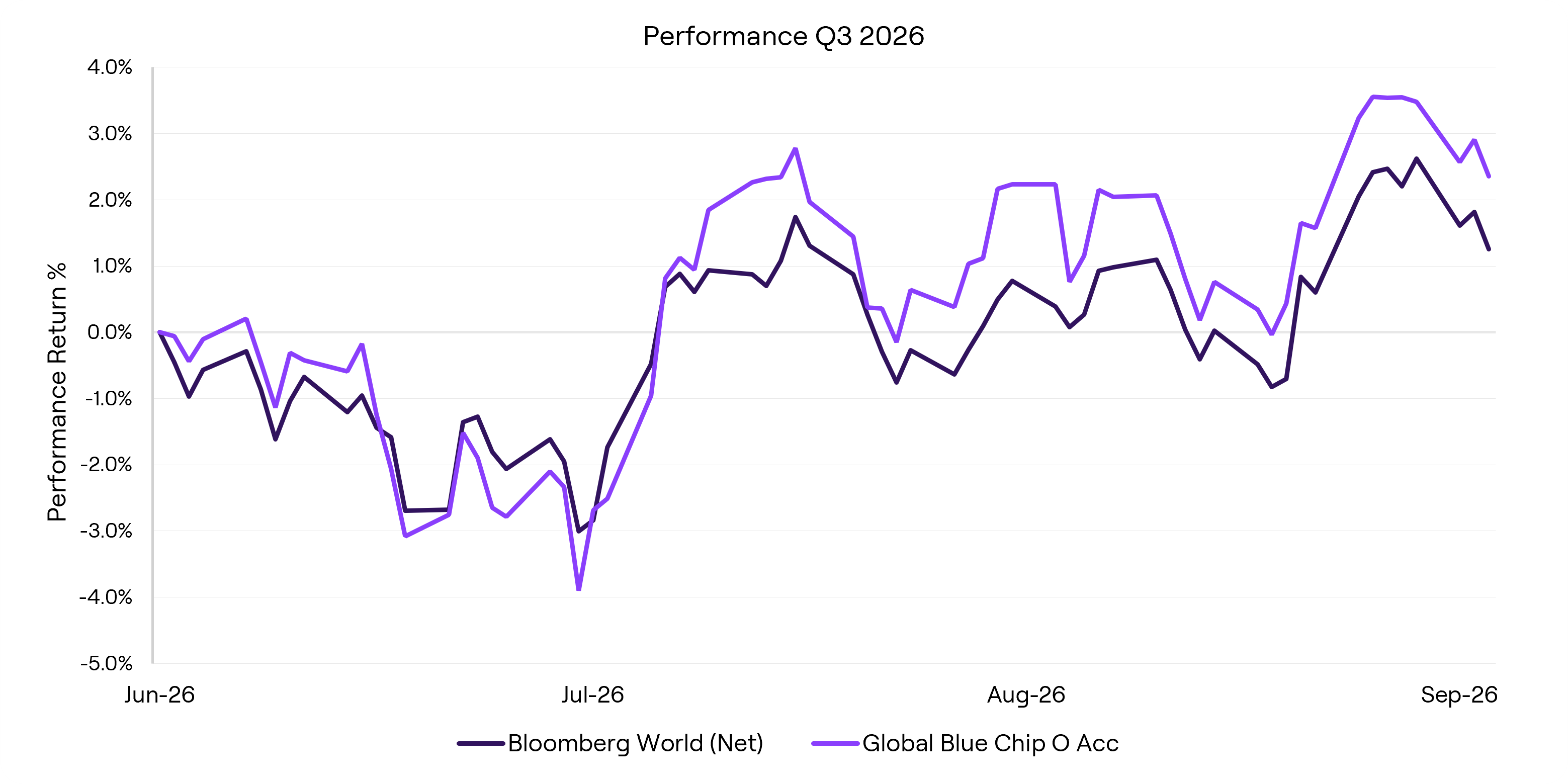
The path to that result was anything but smooth and the fund’s positive performance was achieved against a backdrop of significant market and economic developments including:
- A significant deleveraging event within the AI sector that led to another rotation away from semiconductors and memory stocks towards software and internet names.
- Q2 earnings released midway through the quarter provided greater insight into AI monetisation. These encouraging results helped improve sentiment once the deleveraging phase had largely run its course.
- The threat of military strikes and changing expectations around potential peace agreements in the Middle East contributed to volatility in oil prices and did little to relieve upward pressure on fuel and agricultural product prices, helping sustain inflation and interest rate hike expectations.
- Rising bond yields across G7 nations as investors weighed impressive economic growth, driven primarily by investment in AI infrastructure, with government fiscal discipline and the future direction of inflation.
- Kevin Warsh’s first rate hike as Federal Reserve Chair following September’s Federal Open Market Committee. The decision prompted debate among investors regarding both the necessity of the move and whether it would be sufficient to address inflation concerns.
- Conflicting economic data that continued to support the popular K-shaped economy narrative, although the market finished the quarter expecting four additional rate hikes.
Despite these developments, market conditions during this turbulent quarter were similar to those seen in Q2 and even Q1, which is perhaps symptomatic of the times, but the overarching regime for equity investors has been one of dispersion. While major stock market indices were relatively stable overall, there was significant variation beneath the surface as investors rotated between sectors, as narratives changed swiftly on fast moving developments and the impact such moves may have on individual companies.
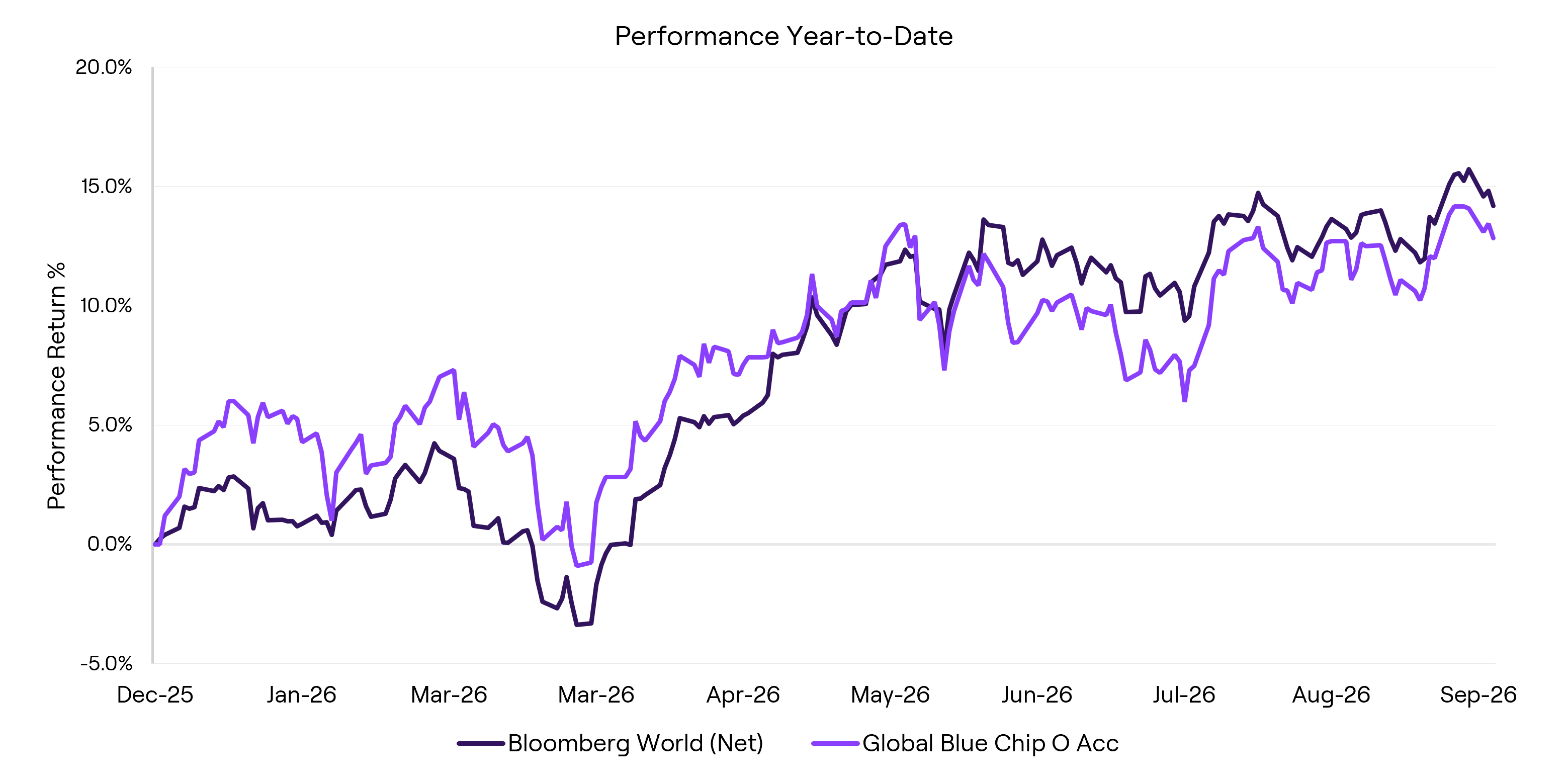
Against this backdrop, the fund trails the benchmark by 1% on a year-to-date basis. We consider this a reasonable outcome given the specific exposures we have selected and the vulnerabilities that this can expose us to in these types of environments.
As we enter Q4, we remain focused on the market’s next move, which we will discuss in more detail below.
Q3 Performance Drivers
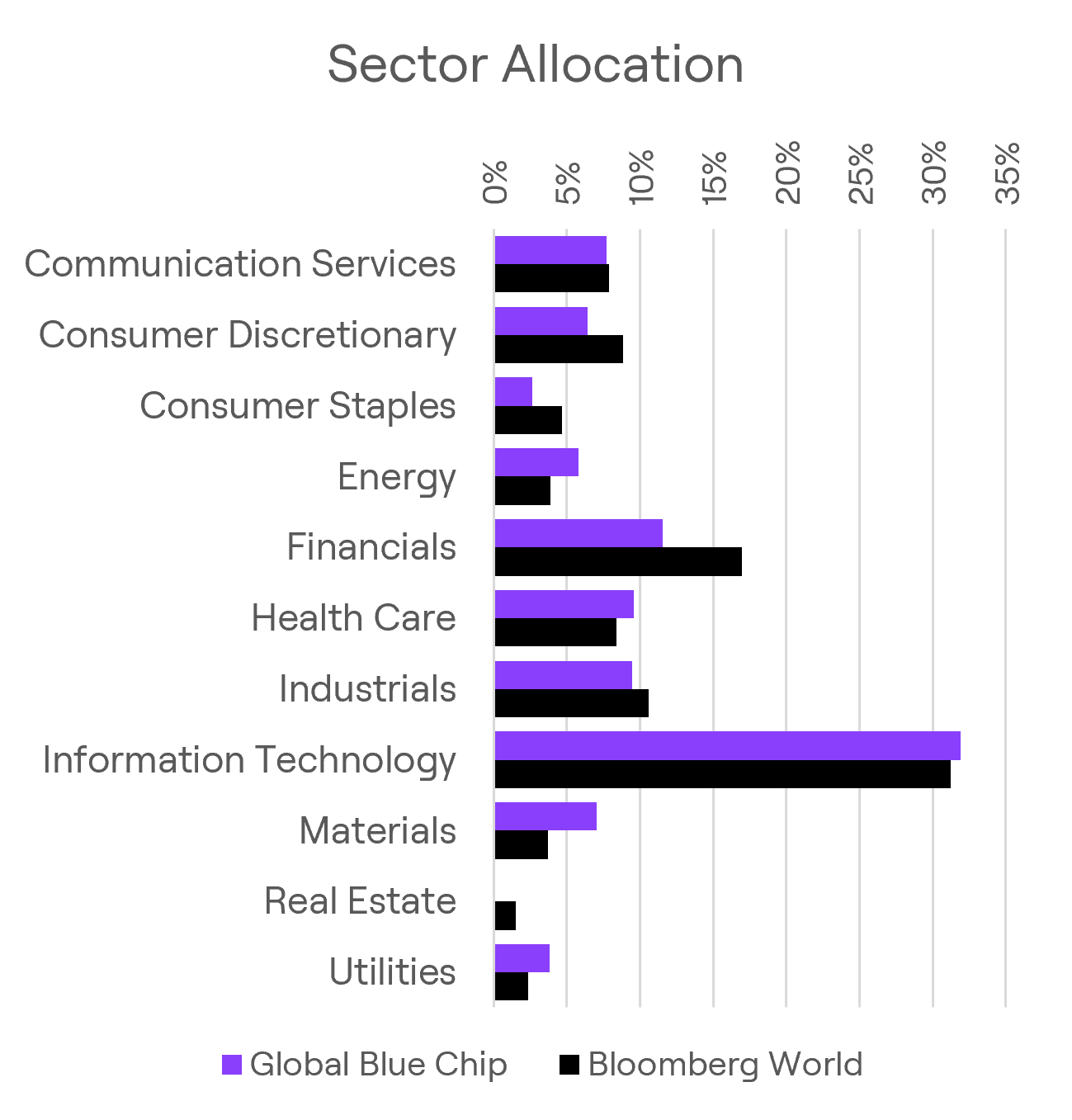
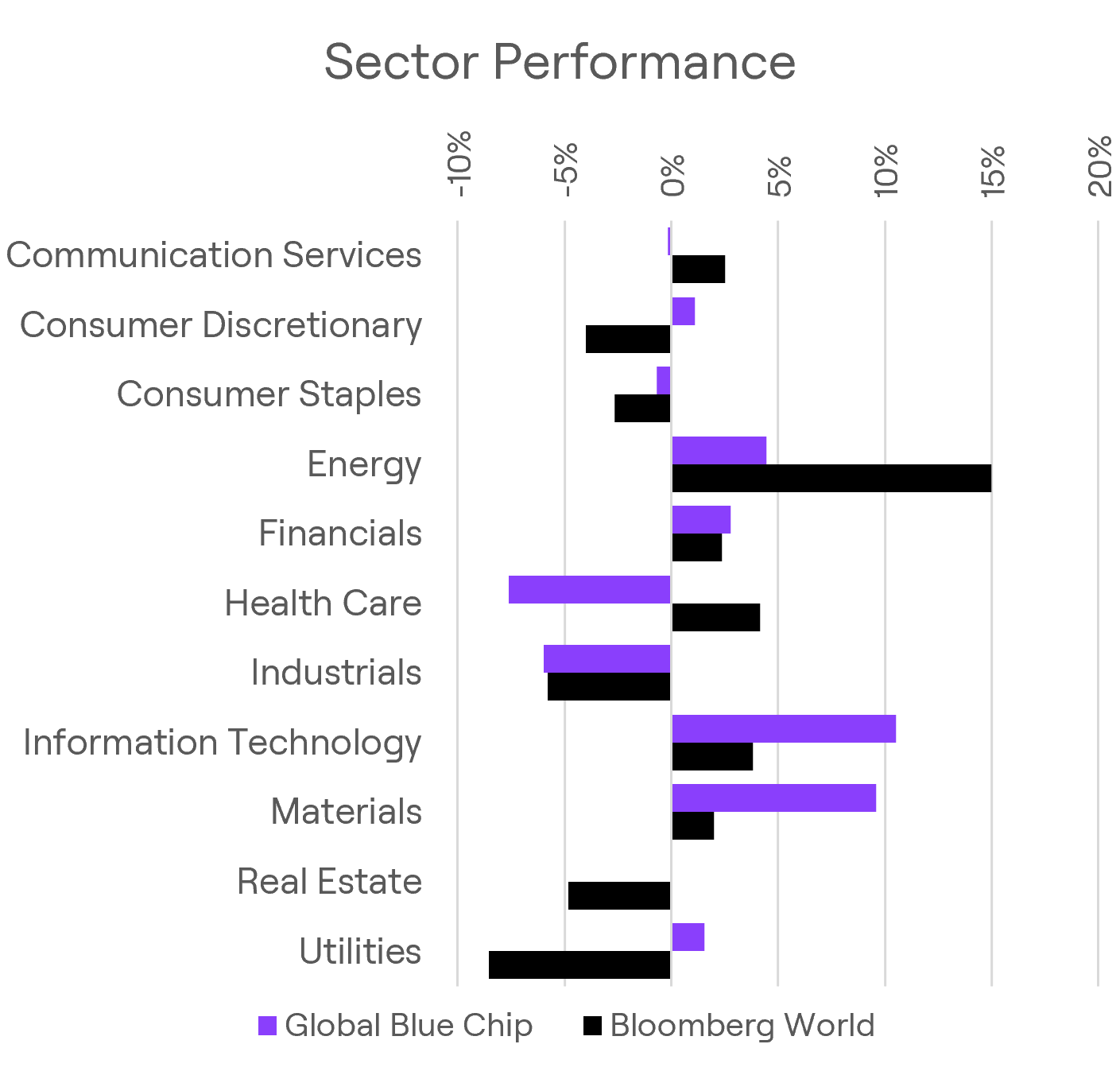
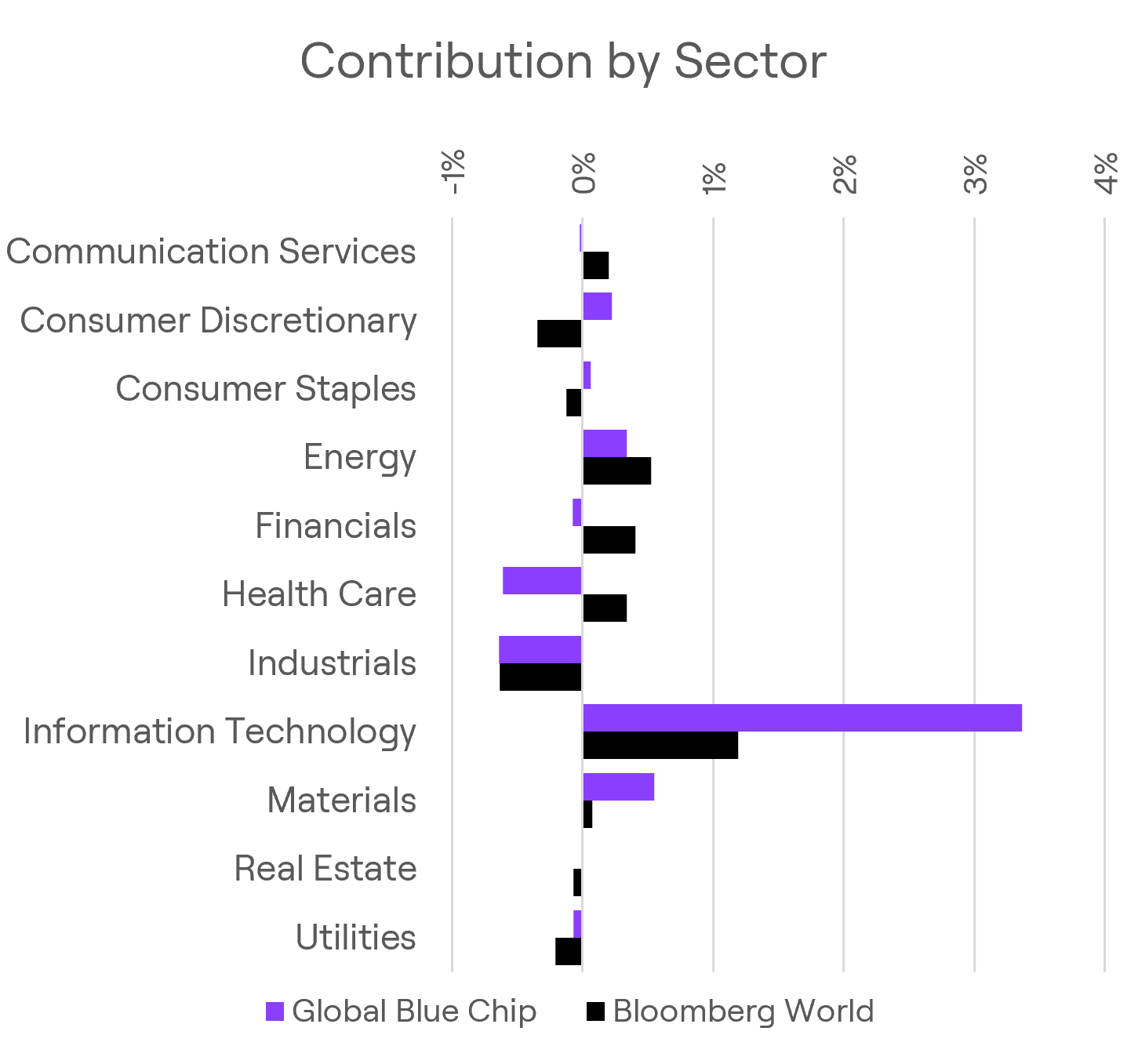
The sector allocation chart shows our aggregate positioning over the quarter. How each sector fared, the movements that counted and how they contributed to performance are explained below:
- Information technology (+3.37%) was the fund’s strongest contributor, while exposure to the sector rose 6%. Technology defined the quarter as AI hardware sold off hard during July’s deleveraging, handing the mantle to software stocks to drive the majority of the contribution. We had built up meaningful positions in businesses that we believe are well positioned to benefit from the continued adoption of AI. These holdings benefited from the continued rerating as capital rotated into the sector through much of August and September. CrowdStrike was the clear winner, contributing over 1% to performance as the narrative surrounding cybersecurity only strengthened following a number of high-profile AI cybersecurity attacks that demonstrated the vulnerability of legacy technology defences. AI industry leaders’ call for a slowdown at the frontier to ensure AI’s safety also dampened sentiment as investors feared a genuine slowdown would lead to a slower rollout of AI infrastructure. Nonetheless, our weighting in technology rose, in part through performance, but also with the addition of Apple as we sought to round out our Magnificent Seven (“Mag-7”) exposure, coupled with incremental top-ups to preferred holdings – especially in software as market performance reinforced the confidence we had in our analysis.
- Materials (+0.55%), exposure reduced by 2.3%. The sector delivered a positive contribution during the quarter, supported primarily by strength in gold-related holdings as investors anticipated that falling inflation would lead to lower bond yields. A sharp rally in gold equities accompanied the move. Our long-term thesis regarding gold remains unchanged, as the metal is a growing asset on central bank balance sheets and China remains a major buyer in the marketplace. We continue to believe that a growing copper deficit will support copper prices over the longer term, although the short-term performance may well be aligned with the fate of the AI hardware trade. Cameco detracted as weakness across the uranium mining sector persisted despite a significant catalyst event in early September. In our view, the recent weakness appears to be driven more by sentiment than underlying fundamentals. Supply and demand dynamics favour producers, which is reflected in term contract prices, with expectations that contract prices are likely to exceed $100 per pound by year-end. Nonetheless, until momentum turns in the equities, we saw little reason to remain invested and exited the position for now.
- Energy (+0.34%), exposure reduced by 2.3%. We reduced energy as part of a broader rebalancing exercise but remain overweight as a hedge against prolonged disruption in the Strait of Hormuz. Our medium-to-long-term rationale remains intact: oil and gas demand should remain firm, supported by the AI build-out and rising consumption across economies such as India and parts of Africa as their economies grow faster than the global average. The position added meaningfully to performance, with integrated energy giant ExxonMobil accounting for the bulk of our exposure’s return. Baker Hughes was broadly flat.
- Consumer Staples and Discretionary (+0.28%), exposure reduced by 1.37%. During the quarter we reintroduced MercadoLibre after a multi-month decline in the stock’s price, driven by competition concerns and elevated investment in its logistics network, which weighed on margins and cash flow. After substantial turnover in the company’s shares, there is reason to believe that a new set of investors owns a good proportion of the business with revised expectations. The company must now demonstrate that this investment can drive margin expansion and strengthen its competitive position, or moat, in key markets. In that regard, Q2 earnings were encouraging. Offsetting the weighting increase was the sale of Unilever after the company guided its sales forecast lower. US sales trends are deteriorating and are likely to hit volumes and the proposed sale of its food business to McCormick also created uncertainty around the strategic business plan. Overall, our consumer selections outperformed sector peers, although it was almost entirely down to our position in Amazon (part of a broader Mag-7 re-rating) and Unilever before its sale. However, these gains were offset by a small decline in MercadoLibre, reflecting the timing of our purchase, and eBay.
- Communication Services (-0.02%), exposure unchanged. We increased our positions in Meta and Alphabet following their underperformance in Q2. Our view was that the decline in many Magnificent Seven stocks during the second quarter, driven by concerns around AI-related spending, had become overdone and that stronger earnings could support a recovery in share prices. Funding this increase was our sale of Netflix following decelerating growth and management’s disappointing guidance. Meta’s shares were under pressure for much of the quarter as investors continued to question the company’s AI strategy until it released Muse, its personal AI agent. Muse gave investors a more tangible route to monetising Meta’s enormous AI investment through paid subscriptions and, ultimately, transaction fees as the agent searches, books and purchases on users’ behalf. Our decision to favour big tech social media (and their AI businesses) was the right relative play, although performance at the sector level was offset by weakness in Netflix and Reddit.
- Financials (-0.07%), exposure increased 5.3%. We added to our exposure with the reintroduction of Visa after news broke about the formation of a consortium that would support a new stablecoin to be called OpenUSD. This removed a primary disruption threat hanging over the stock. The sharp recovery in price following the announcement validated our concerns and reasons for re-entering. Towards the end of the period, we added additional banking exposure to build up an underweight position. Should yields at the front end (or the yield curve) start to come down, this will likely steepen the yield curve, providing a positive backdrop for financial earnings, especially given their critical role in underwriting new issues and loans to the industries that will improve US independence.
- Utilities (-0.07%), exposure declined 0.3%. In order to accommodate our financial positions, we sold German utility company E.On. We retained exposure to RWE, the German power provider, as European energy prices look precariously balanced this winter. We remain optimistic that the disciplined investment will deliver higher power production and increased revenues at attractive rates of return.
- Healthcare (-0.61%), exposure edged higher (+1.37%) after we initiated a position in Novo Nordisk, funded by the sale of Philips. We believed the share price correction of Novo Nordisk had stabilised as investors weighed the prospect of a catalyst in the upcoming investor day. The optimism was short-lived and the stock retraced much of that move as management provided sound guidance but ultimately underwhelmed analysts. We suspect it may take a few reporting quarters to arrest the negative momentum, and the stock is vulnerable to narratives around pipeline and competition. We remain invested but see Q3 earnings as a critical event. Healthcare was a major detractor as UnitedHealth also corrected despite good results. Investors were disappointed by management’s cautious outlook on long-term commercial medical costs and the expected timeline for profit margin recovery.
- Industrials (-0.64%), exposure reduced by 1.57%. We sold L3Harris after it was caught in a perfect storm, which included the abrupt departure of its CEO following a board conduct review that coincided with a broader de-rating across defence stocks. Higher Treasury yields, fiscal concerns and uncertainty over how future defence budgets would be allocated weighed on sector valuations, while the postponement of the company’s Missile Solutions IPO removed an anticipated catalyst despite otherwise strong operating results. The performance of our industrial holdings was almost entirely down to Caterpillar, whose shares were affected by the same macroeconomic concerns and broader investor sentiment towards companies linked to AI infrastructure investment. Towards the end of the period, we increased exposure to the sector with the addition of GE Vernova, the power turbine and renewable energy business that was spun out of the conglomerate General Electric. Our rationale is simple: AI requires significant amounts of power and datacentres are turning to on-site generation as utilities push back on capacity constraints as energy prices get increasingly political.
Looking Forward
We remain constructive on equities, while recognising the risks facing the global economy.
Higher borrowing costs and pressure on lower-income households could weaken consumption, while a strong dollar and geopolitical uncertainty present further challenges for corporate earnings and valuations. However, the more pessimistic market narratives place considerable weight on what could go wrong, whereas continued economic resilience provides grounds for a more constructive stance. Substantial household wealth and cash balances, alongside higher interest income for savers, have the potential to support spending, although these benefits are unevenly distributed.
Artificial intelligence remains central to both the opportunity and the concern. The scale of infrastructure investment raises concerns about excess capacity, uncertain returns and the risk that rapid technological change renders existing assets obsolete. Nevertheless, demand continues to absorb new computing capacity, while competitive pressures on companies and governments support further investment. The expansion of AI into agents, robotics and autonomous systems offers additional scope for growth, and technological progress could sustain demand for new infrastructure even as it shortens the useful life of some existing assets.
Investor sentiment towards parts of the technology sector remains cautious, and a good earnings season could encourage share prices to rise, forcing investors to reappraise their cautious stance, supporting a move higher in the broader indices. Third-quarter earnings therefore represent an important near-term test and a potential catalyst for the direction of markets into year-end.
Our constructive outlook rests on continued economic resilience and evidence of sustained demand, although we remain mindful that financing pressures and disappointing investment returns could challenge that view. We also believe that a higher market may come at the expense of AI infrastructure, particularly semiconductors, as the rally broadens out.
Sovereign Resilience
Investing in the Capabilities Nations Cannot Afford to Lose
For much of the past 40 years, globalisation has been built around efficiency. Production was located where costs were lowest, supply chains became increasingly specialised and capital moved relatively freely across borders. That model delivered enormous benefits, but it also created dependencies that are becoming harder for governments to ignore. Energy shocks, war, trade restrictions and the strategic competition between the US and China have exposed how vulnerable economies can become when essential capabilities sit outside their control. Within our “Changing World” theme, we identify an important long-term trend that we describe as Sovereign Resilience: the rebuilding and protection of the capabilities nations cannot afford to lose.
We believe this period of structural change shares similarities with the “Great Game” of last century, where Britain and Russia competed for influence but without engaging in direct conflict. Today’s competition extends beyond territory, ports, shipping routes and natural resources. It now includes technological dominance, requiring access to advanced semiconductors, frontier AI, secure power generation, robust digital networks and financial architectures – a multi-faceted, multi-domain struggle that includes space. China possesses significant manufacturing, shipbuilding, mineral-processing and energy capabilities, while America retains important advantages in advanced technology, global finance and the dollar.
Governments are recognising vulnerabilities created by decades of outsourcing and underinvestment and are responding with increased spending on defence, energy security, critical minerals, domestic manufacturing and infrastructure. We do not expect the results of that investment to emerge in a linear manner: political priorities, technology and financing conditions will continually change. Nor is government support by itself enough to make a good investment. Our focus is on businesses that control scarce production capacity, intellectual property, specialist equipment, essential infrastructure or services and can assist in building strategic importance whilst generating attractive shareholder returns.
This explains much of the structure of our “Changing World” exposure, which represented approximately 35.8% of the portfolio at quarter-end. Defence remains part of the framework through RTX, while Siemens, Schneider Electric, GE Vernova and Caterpillar provide exposure to automation, electrical infrastructure, power generation and the physical rebuilding of industrial capacity. ExxonMobil, Baker Hughes and RWE address another basic requirement: secure and reliable energy. Glencore provides exposure to strategically important industrial materials, while Agnico Eagle and AngloGold introduce an additional dimension through gold, which increasingly sits not only as an investment asset but as potential sovereign monetary insurance.
Financial infrastructure matters too. Reindustrialisation, defence, AI datacentres and energy systems require enormous amounts of capital. That is one reason we have increased exposure to US investment banks, including Goldman Sachs and Morgan Stanley alongside JPMorgan. Investment banks sit at the centre of raising, lending, syndicating and hedging that capital. Visa, Coinbase and other payment-related exposures address another emerging battleground: the financial rails through which money moves. The development of stablecoins and tokenised assets may ultimately reinforce rather than weaken the dollar system, further connecting financial infrastructure with national strategy.
Within this framework, technology and innovation, which currently sits around 38.3% of the portfolio, is becoming increasingly important. AI is no longer simply a technology theme; it is becoming a source of productivity, military capability and national competitiveness. As we have discussed in multiple updates, intelligence requires physical infrastructure. Datacentres need processors, memory, networking, cooling and, above all, electricity. The scale of investment required means that access to dependable power may eventually be as strategically important as access to advanced semiconductors.
Our technology holdings therefore span the system rather than one narrow part of it. Nvidia, AMD and Broadcom provide compute; TSMC supplies advanced manufacturing; ASML and KLA provide difficult-to-replicate semiconductor manufacturing equipment; Micron supplies increasingly critical memory; Arista addresses networking; and Infineon provides power semiconductors relevant to the higher-voltage architectures required by future AI datacentres. Microsoft, Alphabet, Meta, Palantir, ServiceNow and CrowdStrike sit further up the stack, where infrastructure is converted into software, productivity and security.
This connection between the physical and digital worlds is central to “Sovereign Resilience”. The result is a portfolio increasingly organised around a simple question: where are the strategic bottlenecks in a less globalised world and who captures the economic value created as nations attempt to secure them? “Sovereign Resilience”, we feel, provides the framework for answering it. It connects technology with energy, finance with industrial policy and national security with capital allocation. If the coming decade is defined less by frictionless globalisation and more by strategic competition, the companies supplying capabilities that governments and economies cannot afford to lose should sit at the centre of one of the most important investment cycles of our time.
Stock In Focus: ServiceNow
ServiceNow is one of the less visible but increasingly important pieces of software used by large organisations. Its original purpose was relatively straightforward: take complicated business processes that relied on emails, spreadsheets and people manually passing work between departments, and turn them into structured digital workflows.
Consider a new employee joining a large bank. Human resources may create the employee record in their HR system, Microsoft needs to provide an email account, IT must order and configure a laptop, security teams need to approve access to internal systems and finance may need to establish expense permissions. ServiceNow does not necessarily replace any of these systems. Instead, it sits between them, determining what needs to happen, in what order, who needs to approve it and which system should perform the action.
The same architecture originally transformed IT support. If an employee’s laptop failed, ServiceNow could identify the employee and device, establish which applications were affected, route the problem to the appropriate team and monitor resolution. Its Configuration Management Database, or CMDB, gradually became a detailed map of a customer’s technology environment and how individual applications, devices and infrastructure relate to important business services.
These examples help explain ServiceNow’s importance, as does the fact that around 90% of Fortune 500 companies now use ServiceNow (according to the company). SAP, for example, might remain the system of record for financial information and Workday, as another example, for employees, but ServiceNow increasingly became the system through which work was organised and executed.
Over time, the company has expanded its approach beyond IT into human resources, customer service, cybersecurity, governance and finance. Tools such as Flow Designer enabled customers to automate processes with relatively little coding, while App Engine allowed businesses to construct their own applications on the platform. The deeper ServiceNow became integrated into an organisation, the more valuable – and difficult to remove – it became. Replacing the software would potentially mean rebuilding thousands of workflows, permissions, integrations and business rules accumulated over many years.
AI changes the opportunity
We believe AI is set to materially enhance this model. Historically, ServiceNow primarily organised work performed by humans. AI increasingly allows ServiceNow to perform parts of that work itself.
Returning to our laptop example, the traditional platform would identify the problem, create a ticket and route it to the appropriate employee. An AI-enabled ServiceNow can increasingly identify the device, examine previous incidents, determine the probable cause, interrogate other systems, execute an approved fix and test whether the problem has been resolved – only involving a person when necessary.
That changes ServiceNow from workflow management software into something closer to an operating layer for autonomous enterprise work.
The company has responded by building several capabilities that become increasingly important as businesses deploy AI agents. Workflow Data Fabric connects information held across different enterprise systems. The Context Engine gives AI an understanding of what that information means within a particular organisation. Action Fabric allows agents to use ServiceNow’s existing workflows and business rules to carry out tasks. Finally, AI Control Tower provides oversight of AI models and agents, controlling what they are permitted to do and maintaining the audit trails required by large organisations.
Governance could become particularly valuable. Allowing an AI model to summarise a document creates relatively limited risk. Allowing an autonomous agent to approve expenditure, alter employee permissions or modify an important database is entirely different. Companies need identity controls, permissions, auditability and the ability to intervene when an agent behaves unexpectedly. ServiceNow already possesses much of this infrastructure.
From software seats to autonomous work
The commercial evidence is encouraging. ServiceNow’s AI products exceeded $1 billion of annual contract value in Q2 2026, while subscription revenue grew 24.5%. Management subsequently raised its 2026 AI contract-value target to approximately $1.5 billion and believes AI products could ultimately represent around 30% of total contract value by 2030.
AI contract revenue is becoming more important as a metric because AI is challenging the traditional software industry’s reliance on charging according to the number of employees using an application. If one autonomous agent can perform work previously requiring many people, the number of human software seats becomes less relevant. ServiceNow therefore has an opportunity to monetise activity, workflows and outcomes, rather than simply human users.
Why better LLMs may strengthen rather than destroy the platform
There is also an obvious challenge. Frontier models from OpenAI, Anthropic, Google and increasingly capable Chinese providers can connect directly to enterprise applications and execute tasks themselves. Open standards such as Model Context Protocol make those connections easier. In theory, an AI model could eventually interact directly with Workday, Microsoft and other systems and recreate workflows without ServiceNow sitting in the middle. However, ServiceNow is responding by embracing, rather than fighting, external models.
A frontier model provides intelligence, but it does not automatically understand an individual company’s permissions, historical decisions, regulatory requirements or approval processes. Much of that institutional knowledge has already been encoded within ServiceNow through years of workflows, identities, assets, permissions and business rules. This creates what might be thought of as the ‘process graph’ of the enterprise.
ServiceNow is therefore opening its execution infrastructure to external agents. An employee may ultimately interact through ChatGPT, Claude or Copilot without ever seeing a ServiceNow screen, but ServiceNow can still provide the trusted machinery underneath that interaction: context, permissions, governance and execution.
For our investment thesis to prove true, we require ServiceNow to remain the trusted layer through which increasingly powerful models are permitted to understand and act upon the enterprise. If AI agents proliferate as we expect, that layer may become more important, not less. ServiceNow would continue to move from helping people perform work to becoming part of the infrastructure through which the work itself gets done, improving value for both ServiceNow and its customers.