
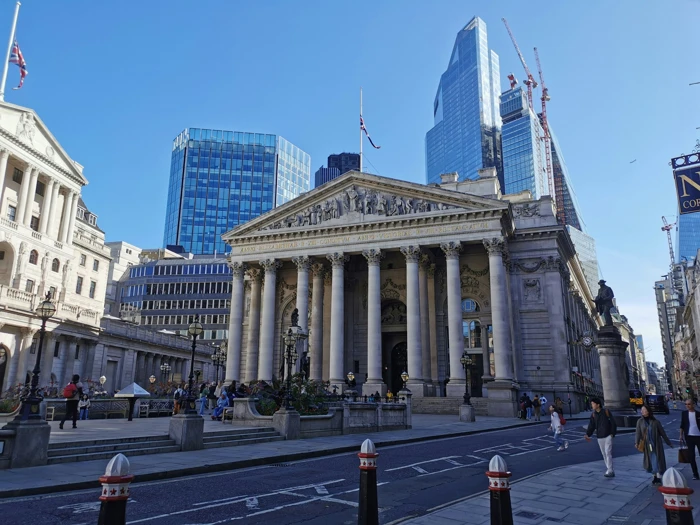
This week’s update is written by Pierre Paul, who is part of our cash management team in Guernsey.
Inflation has started to rise again and government bond yields have followed suit. The European Central Bank raised its equivalent of Base Rate on 10th September, and the US Federal Reserve Bank did the same on 16th September. The Bank of England (“BoE”), by contrast, kept its Bank Rate (more widely known as base rate) steady at 3.75% at its meeting on 17th September but is expected to raise it to 4% at its next scheduled meeting in November.
UK inflation has remained stubbornly above target for much of the past five years and its recent upward trajectory could worsen the pressure on households as energy prices continue to rise. This does not augur well for those hoping that the BoE does not tighten monetary policy.
Most of us are familiar with the accepted principle that the BoE raises or lowers the base rate to influence economic activity and help meet its 2% inflation target. At times it seems like a fairly blunt tool and it could be argued that raising interest rates when the economy is facing hardship as a result of higher energy prices will only cause further economic hardship.

This raises the question of whether the BoE has any other tools at its disposal to help manage inflation. The answer is that its toolbox is relatively limited; with one notable additional instrument: the newsreader’s nightmare, quantitative easing (“QE”).
So, what is QE and how can it be used as a tool for central banks to meet an inflation target? To help navigate the technical aspect of this subject, we’ve put together a brief glossary of the main terms at the bottom of this article.
When the BoE needs to reduce the rate of inflation, it raises interest rates. Higher interest rates mean borrowing costs more and saving gets a higher return. That leads to less spending in the economy, which brings down the rate of inflation. When it needs to support the economy by boosting spending, the BoE lowers interest rates. That also causes inflation to go up.
QE is the other main tool available to the BoE to lower interest rates. It first used QE in March 2009 in response to the Global Financial Crisis. At that time, Bank Rate was already very low, so the bank needed another way to lower interest rates, encourage spending in the economy and meet its inflation target.
QE involves the bank buying bonds to push up their prices and bring down long-term interest rates. In turn, that increases spending across the economy, putting upward pressure on the prices of goods and services.
In total, the BoE bought £895 billion of bonds, including mainly UK government bonds and around £20 billion UK corporate bonds.
The BoE uses its reserves to buy bonds. These reserves are not funds raised through government taxation or borrowing. Instead, like other central banks, the bank can create money digitally in the form of “central bank reserves”. The BoE is not alone in using QE. Central banks in many other countries, including the US, the Eurozone and Japan, have used it too.
QE helps keep interest rates low, which reduces longer-term borrowing costs for households and businesses. This stimulates spending throughout the economy and can help raise inflation if it falls below target.
Buying bonds can also support the prices of other financial assets, such as equities and property. This has led to criticism that QE can increase wealth inequality by boosting the value of assets owned by those who already hold them. However, QE also leads to more spending, which creates jobs and increases wages. As a result, those of employment age benefited from higher earnings, and, according to BoE reports, it was younger people who benefited the most from the support to employment and incomes.
The process of ‘unwinding’ QE is sometimes called quantitative tightening (“QT”). This can be done by not replacing bonds when they mature, by actively selling bonds to investors or by using a combination of both approaches.
Unlike QE, which is used to reduce interest rates and therefore support inflation, the aim of QT is not to affect interest rates or inflation directly. Instead, the aim is to ensure that the bank has the capacity to use QE again in future, should it be necessary to achieve its inflation target.
Just as with QE, it is the Monetary Policy Committee that decides on QT.
The BoE plays a crucial role in shaping the UK economy and influencing the financial wellbeing of households and businesses alike. With only a limited set of tools at its disposal, meeting its inflation target is no easy task.

Glossary
- Bank of England - The UK’s central bank. In this article, we refer to it as the BoE.
- Bank Rate - This is the interest rate paid by the Bank of England on deposits held with it by commercial banks operating in the UK.
- Base Rate - This is the same as Bank Rate but base rate is the term used by most people and media. • Central banks - These are state-supported institutions responsible for overseeing the banking sector, using regulations to help ensure the safety and stability of customers’ deposits.
- Commercial banks - These are all licensed banks that operate in the UK. We are most familiar with high street banks like Barclays, HSBC, Lloyds and NatWest but this term covers all other banks including non-UK banks like Citibank from the US and BNP from France. All commercial banks are required by law to place some of their reserves on deposit with the BoE. This is to help create financial stability.
- Inflation - Measures how much the prices of goods and services have increased. The UK’s Office for National Statistics collects data to calculate inflation through the Consumer Price Index (CPI). The UK’s inflation target is currently 2%.
- The Monetary Policy Committee (MPC) - The committee that decides on Bank Rate and QE.
- Quantitative Easing (QE) - This is where the bank buys bonds to bring down longer-term interest rates on savings and loans.