
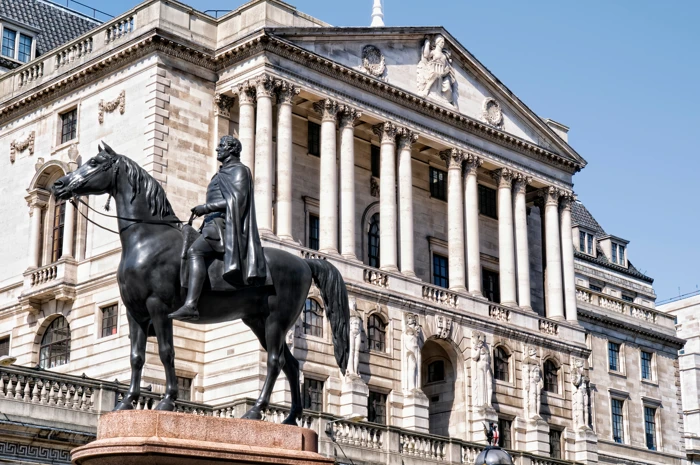
You may have come across references to the Bank of England's Monetary Policy Committee (“MPC”) in our market updates. Given its role in setting UK interest rates, we thought it would be useful to take a closer look at the committee and how it operates.
Before the committee was established in 1997, the Chancellor of the Exchequer set interest rates assisted by a committee of ‘wise men’. The new Labour Government abolished this system and gave the Bank of England (“BoE”) independence. Subsequently, the BoE created the MPC to set UK interest rates.
The committee is made up of nine members, including five senior BoE officials, the Governor who chairs the meeting and four external economists, each appointed for a fixed term by the Chancellor. Every member has a vote and decisions are made by a simple majority. In the event of a tie, the Chairman has the casting vote.
The committee’s primary objective is simple: to maintain price stability by keeping inflation close to its 2% target, measured by the Consumer Price Index.
Some notable moments in the MPC’s history include:
- 2008 financial crisis: The bank rate was aggressively slashed from 5% down to an historic low of 0.5% in early 2009 to support the freezing financial system.
- Covid-19 Pandemic (2020): Rates dropped to a record low of 0.1% in March 2020 and there were real concerns that official interest rates could turn negative.
- Post-pandemic inflation spike (2023): Rates rose rapidly to combat surging post-pandemic inflation, peaking at 5.25% in August 2023.
Recent developments have seen interest rates gradually ease between August 2023 and late 2025 before stabilising. In early 2026 the opinion was that official rates would follow inflation lower. However resurgent global energy prices have caused a re-assessment. Current interest rates are 3.75% and inflation at 2.9%. With inflation still above the bank’s 2% target and concerns that increased energy costs could add further pressure, markets are anticipating that the next move in interest rates will be upwards.

One of the more unusual moments in the MPC’s history came in August 2025, when a second vote regarding changes to rates was required. The committee was grappling with sluggish economic growth and above-target inflation. The original vote saw four people vote to cut rates by 25 basis points, four people vote to leave rates unchanged and one individual vote to cut rates by 50 basis points. The result was an unusual split, with no majority. The chairman called for another vote and Alan Taylor, the individual who voted to cut rates by 50 basis points, switched to a 25-basis point cut. And so, the decision to reduce rates by 25 basis points was carried.
As BoE officials move on and external members reach the end of their terms, the make-up of the committee naturally evolves. This means that priorities, concerns and even the importance placed on different economic indicators can change over time.
For example, one of the most closely watched indicators in the MPC’s early years was the UK purchasing managers’ index (“PMI”). This is an index calculation with a reading of 50 indicting neither economic expansion nor contraction. Readings above 50 suggest expansion, while below 50 points to contraction. For a time, a reading above 55 would be strong enough for the committee to immediately raise interest rates. The velocity of money has also enjoyed periods of prominence. While both indicators remain relevant today, the relationship between these figures and interest rate movements is perhaps less direct than it once was.
One topic attracting increasing attention today is central bank credibility. We’ve mentioned several times that UK inflation remains above the BoE’s 2% target. In fact, CPI inflation has been above target for around five years. Normally, inflation at these levels would strengthen the case for higher interest rates. However, policymakers have argued that much of the inflationary pressure has come from the supply-side factors while economic growth has remained anaemic.
As a result, the MPC recently chose to cut interest rates to support the economy, placing confidence in forecasts that inflation will continue falling. However, geopolitical tensions in Ukraine and the Middle East have complicated that outlook, contributing to inflation remaining higher than expected. Given how long inflation has remained above target, some committee members have warned that the credibility of the committee is at risk. Fundamentally the MPC has one target and if it is not achieving this then markets could start to place less weight on the committee’s guidance and place greater emphasis on their own expectations for interest rates.
Inevitably if trust is lost it would be very difficult to regain it. This is one reason why many commentators believe rates will remain higher for longer and why the chances of interest rates returning to ultra-low levels are currently viewed as unlikely.
The MPC plays a vital role in connecting economic conditions with everyday life. Its priorities may evolve as members change and economic circumstances shift, but the importance of its decisions remain constant. Whether you’re an investor, borrower or saver, the MPC’s actions help shape the economic environment we all experience.