
Q2 was a challenging quarter for the Titan Global Blue Chip Fund. While our positioning generated a strong absolute return of 7.83% in GBP terms, the MSCI World returned 13.16%.
We pay close attention to benchmark weights, but we are deliberately selective in the exposures we choose to own, based on our thematic work and fundamental analysis. During Q2 the market became increasingly selective too. Capital rotated rapidly between sectors, subsectors and even between companies exposed to the same structural theme, resulting in what investors refer to as dispersion. At the headline index level things often looked remarkably calm; beneath the surface it was closer to an all-in bar brawl, with money moving aggressively from one perceived winner to the next without necessarily leaving equities altogether.
It is worth addressing the difference in returns generated by the onshore OEIC and the offshore unit trust. The two funds use different cut-off times when calculating their net asset values: the onshore fund cuts off at midday, while the offshore fund cuts off at midnight. As a result, moves in the US market are reflected in the onshore NAV the following day, whereas the offshore fund cuts off at midnight. As a result, moves in the US market are reflected in the onshore NAV the following day, whereas the offshore fund captures them on the same day. The quarterly performance chart below shows the rally from 31st March appearing in the onshore NAV on 1st April. Over time these timing differences even out, but they can create divergences around important reporting dates such as quarter end.
Q2 Performance
The strength of our chosen technology exposures - particularly semiconductor manufacturing, process control and cybersecurity - did much of the heavy lifting for the portfolio. However, it was not enough to offset areas where holdings came under pressure or where we simply did not have sufficient exposure to the narrow group of stocks driving the benchmark. In this update, we will explain where that relative shortfall came from, what we continue to learn about the changing nature of market leadership and how this quarter has influenced the way we intend to build the portfolio.
The good news is that the setback did not undo the progress made earlier in the year. Global Blue Chip is up 9.8% year-to-date as of the end of June, which is only 1.5% behind the benchmark.
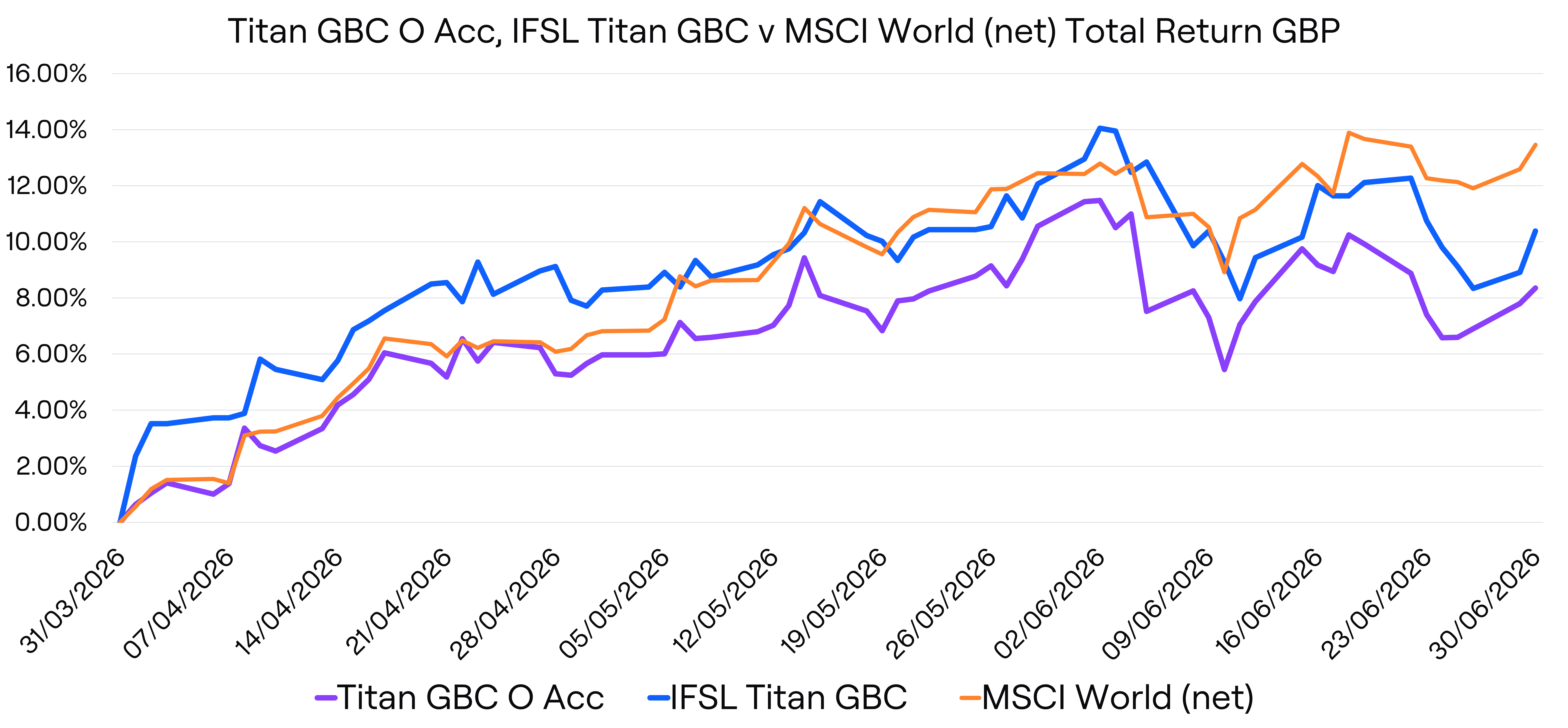
Data Source: Bloomberg 31/03/2026 – 30/06/2026
Year-To-Date Performance
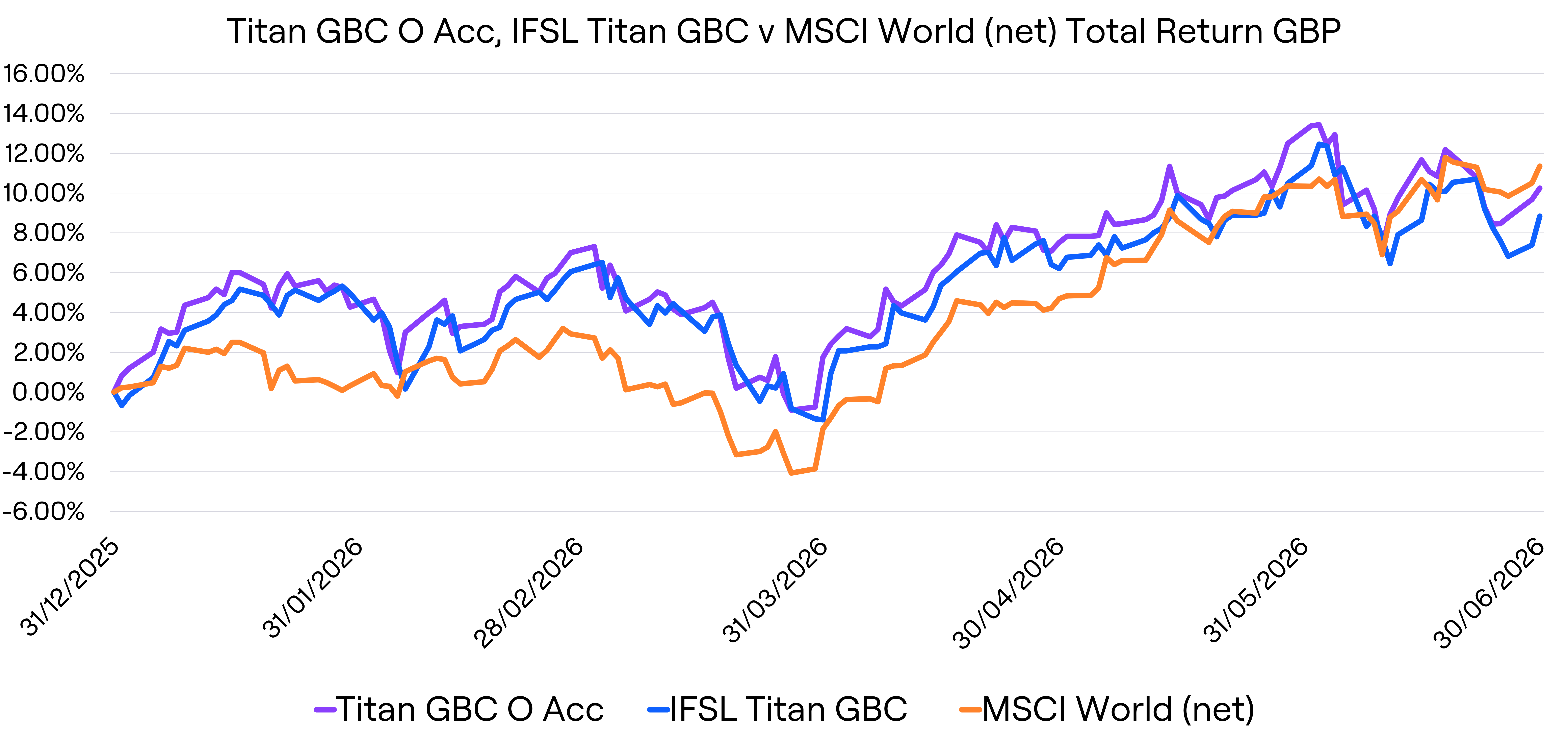
Data Source: Bloomberg 31/12/2025 – 30/06/2026
Q2 Sector Allocation, Performance and Contribution
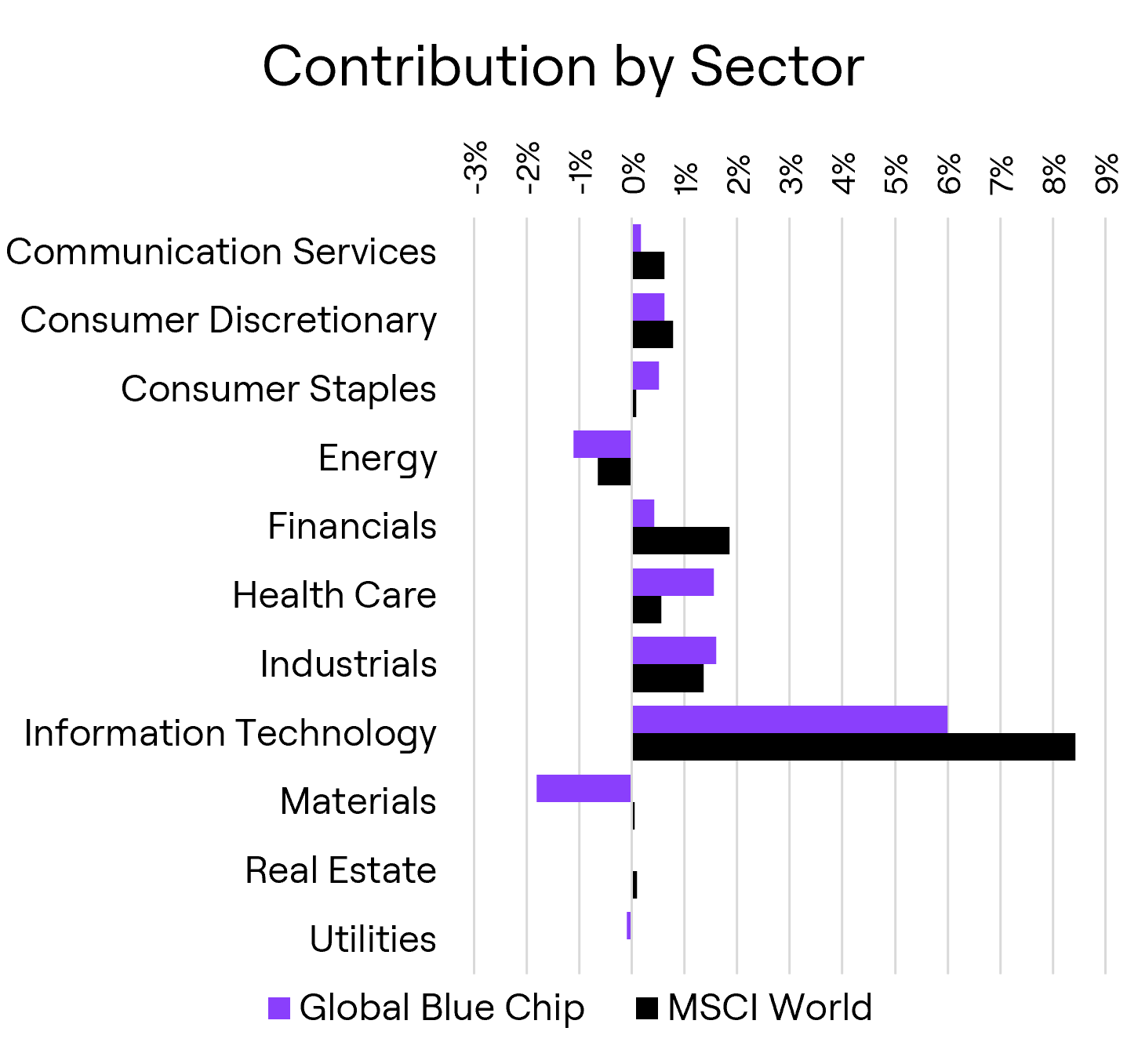
The charts below illustrate the returns through our sector exposures. The first shows our average sector positioning relative to the benchmark, the second compares the performance of our holdings within each sector and the third combines those two effects to show actual contribution. Taken together, they highlight an important feature of Q2: it was not simply a question of whether a sector went up or down, where we were positioned within each sector increasingly mattered just as much as the sector allocation itself.
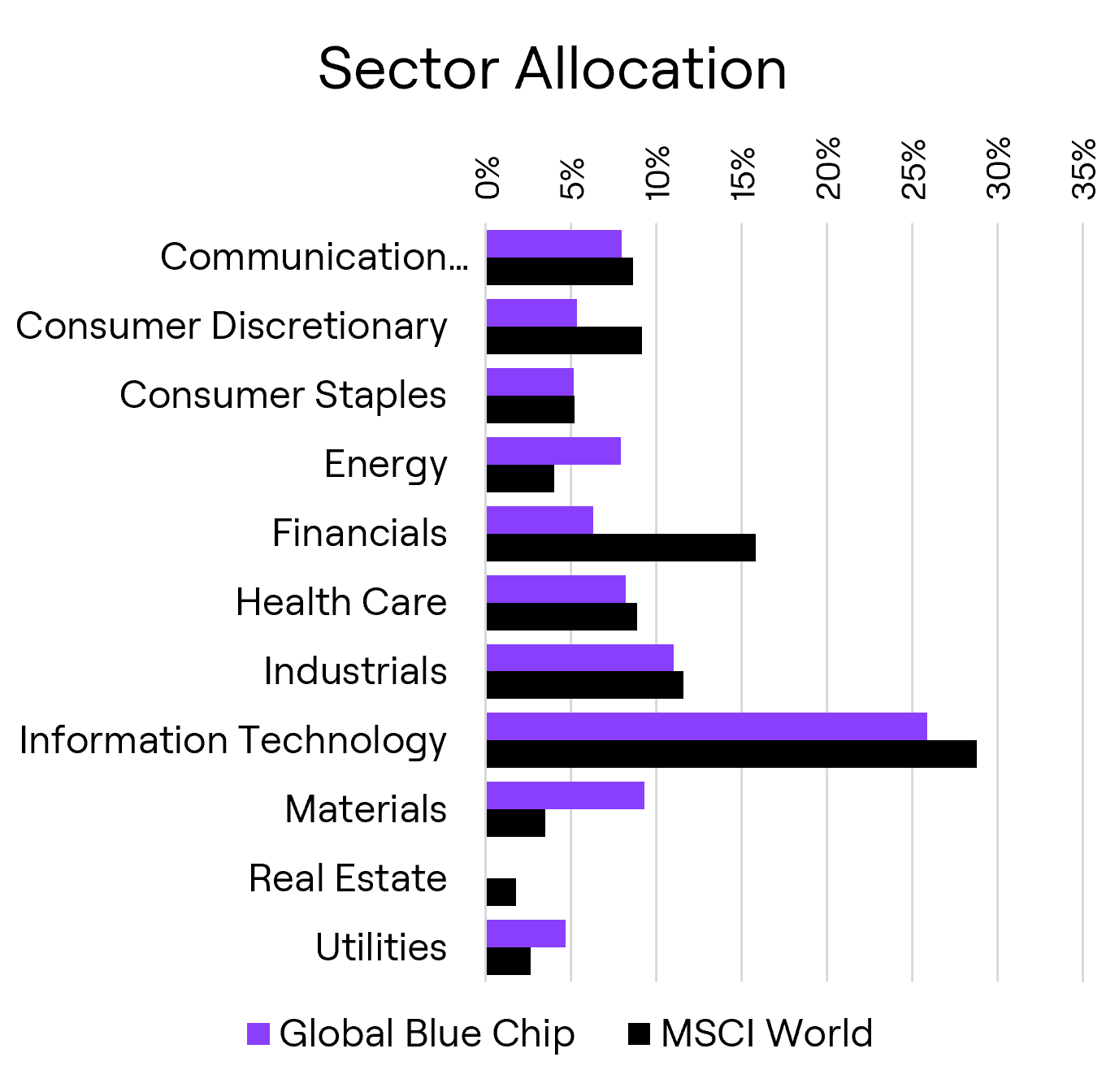
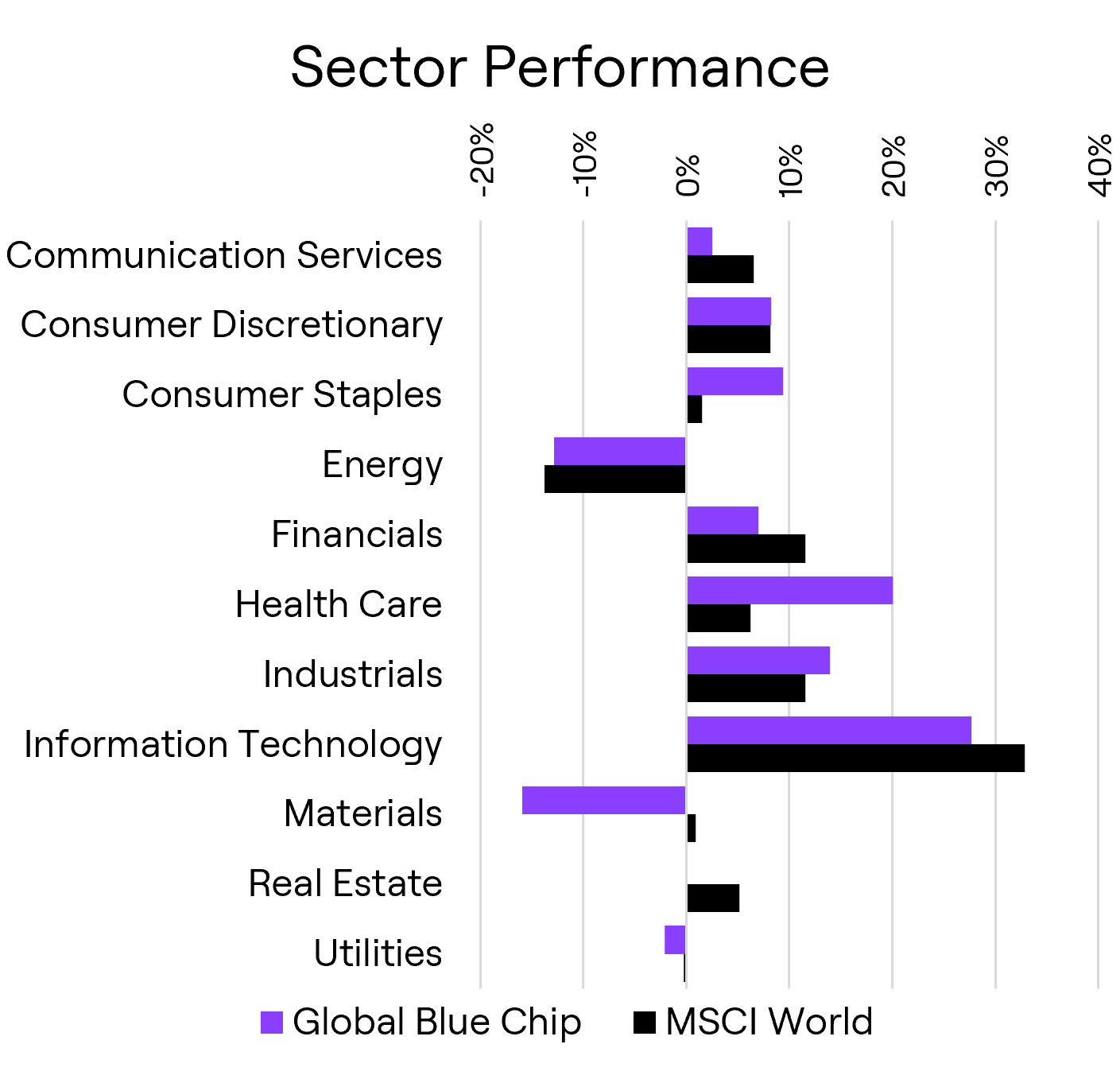
Data Source: Bloomberg 31/03/2026 – 30/06/2026
AI: the Biggest Absolute Contributor and Our Biggest Relative Headwind
We have spoken at length about this in previous communications, but it is worth reiterating that the AI investment case spans far more than the technology sector. Mapping the theme from end to end reveals a chain of potential constraints stretching from semiconductors and memory through to networking, datacentres, power generation, cooling and the grid.
The common feature is that demand is growing faster than parts of the physical system can comfortably accommodate. New capacity is coming, but fabs, packaging lines, datacentres, turbines, transformers and transmission infrastructure take time and enormous amounts of capital to build. Manufacturers therefore face a difficult balancing act: invest too little and shortages persist; invest too much and they risk creating excess capacity later. For now, that tension continues to create opportunities across the stack:
- IT hardware: accelerators, CPUs, memory, storage, racks and networking all matter, but the bottleneck is not static. As one constraint eases, another can become more important. That is exactly what happened in Q2 as investor attention shifted sharply towards memory and other parts of the system required to keep increasingly powerful compute fed with data.
- Production: more demand for advanced chips means more investment in foundry capacity and the equipment needed to manufacture them. Our holdings in ASML and KLA provide exposure to this trend, supplying essential equipment that helps chipmakers improve yield, quality and production efficiency as chip complexity rises.
- Compute: datacentres are the physical factories in which AI workloads run. Hyperscalers such as Alphabet, Microsoft, Amazon and Oracle continue to commit very large sums to new capacity, while specialist compute providers are also expanding. This creates demand well beyond the chips themselves: land, buildings, electrical equipment, networking, cooling and financing all become part of the equation.
- Power: AI datacentres consume extraordinary amounts of electricity and increasingly require power on a scale normally associated with heavy industry. Multi-gigawatt campuses are now being planned, placing pressure on generation, transmission, transformers, switchgear and cooling. That creates unusually long visibility for parts of the power and electrical-equipment supply chain, and it is one reason we increasingly see AI infrastructure as overlapping with our broader work on energy security and sovereign resilience.
This is why AI is much more than a technology trade. It reaches into industrials, utilities, communication services, materials, energy and, increasingly, finance. The physical and financial infrastructure required to support AI is becoming almost as important as the models themselves.
That breadth also makes the theme harder to own, and Q2 was a good example of why. Money did not leave AI; it moved dramatically within it. Memory and selected CPU-related names surged, GPU shares were comparatively subdued, hyperscalers lagged despite continuing to spend, cybersecurity recovered strongly and software split into perceived winners and losers. The portfolio benefited from AI in absolute terms, but the benchmark benefited more because the strongest part of the trade happened to be concentrated in areas where we were underweight.
The most painful omission was direct memory exposure. A combination of genuinely strong fundamentals, rapidly rising prices, increasingly vocal industry commentary and growing investor leverage sent memory stocks into a parabolic move. Micron, for example, rose from roughly $338 at the end of March to $1,154 by the end of June and briefly joined the $1 trillion market-cap club. We were not completely absent from the sector: advanced memory still has to be manufactured, so Taiwan Semiconductor Manufacturing Company (“TSMC”), ASML and KLA all benefited indirectly from the investment cycle. However, this indirect exposure was not quite enough to offset the extraordinary performance of the memory producers themselves.
The contrast with GPUs was striking. Nvidia, which is held within the portfolio, gained only around 15% over the quarter, while some CPU-related names performed far more strongly. That did not mean CPUs had suddenly replaced GPUs for AI inference - large models still rely heavily on accelerators. Rather, the market was recognising that the AI system is broader than the GPU alone. CPUs remain essential as host processors, inference is broadening into a wider range of workloads and model architectures are becoming more diverse. ARM Holdings became one of the clearest expressions of that enthusiasm, while Advanced Micro Devices (“AMD”) benefited not only from its accelerator roadmap but also from strong demand for its EPYC server CPUs. The lesson was less ‘CPU beats GPU’ and more ‘the value pool is spreading across the compute architecture’.
This is where dispersion becomes important. Money has to come from somewhere. If fresh capital is not entering the market fast sell - or sell short - the names they believe have lost the narrative in order to buy the names that currently have it. We saw this earlier in the year during the so-called Software as a Service “Saas”-apocalypse, when rapid progress in AI coding models led investors to treat large parts of software as obsolete and use the sector as a funding source for hardware. Q2 showed the same behaviour within AI itself: baskets of perceived winners were bought aggressively while perceived losers were sold, sometimes with surprisingly little regard for the underlying change in fundamentals.
So, how should we respond when the AI trade behaves like this? Rather than devoting more time to guessing which hedge-fund basket will be bought next and trying to get ahead of it – which would only lead to more trading, more noise and more volatility - the answer, in our view, is to broaden the portfolio modestly across the most important parts of the AI stack. If the buildout continues and the economic value of compute keeps rising, several bottlenecks should continue to create value over time even if market leadership rotates between them. That argues for smaller positions across a wider group of complementary leaders - including memory - rather than relying too heavily on a handful of obvious winners. Our main job then becomes assessing whether the underlying spending remains affordable and productive.
The relative underperformance our Magnificent Seven holdings created another headwind. Alphabet, Meta, Microsoft and Amazon collectively lagged as investors rotated away from companies writing the biggest AI capex cheques and towards the suppliers receiving them. The record SpaceX IPO added another twist. The deal raised $75 billion and the shares finished their first day above a $2 trillion valuation, absorbing a huge amount of risk capital at a time when existing mega-cap technology was already under pressure. By then SpaceX also included xAI, so investors were effectively underwriting rockets, Starlink and a rapidly expanding AI-compute business in the same vehicle. The valuation captured both the scale of the opportunity and the extraordinary expectations now embedded in parts of the AI ecosystem.
It was not all doom and gloom, however. Semiconductor manufacturing and equipment holdings such as TSMC, ASML and KLA remained comparatively resilient. Their attraction is that they do not require us to know whether the ultimate winner is Nvidia, AMD, a hyperscaler-designed ASIC or some future architecture. If advanced semiconductors continue to proliferate, the manufacturing complexity and capital intensity still have to pass through the foundries and their equipment suppliers.
CrowdStrike was another major winner as the market’s view on cybersecurity shifted from ‘AI is a threat to software’ towards ‘AI creates a new security problem that must be solved’. Anthropic’s Mythos Preview helped crystallise that change in thinking by demonstrating how capable frontier models were becoming at identifying software vulnerabilities. More autonomous agents mean more identities, more machine-to-machine activity and a much larger attack surface.
The fundamentals then gave investors something tangible to support the narrative: CrowdStrike reported strong results, with revenue growing 26% year-on-year and record free cash flow, while management also upgraded its growth outlook for the year ahead.
CrowdStrike’s Falcon Flex subscription model was especially encouraging, with annual recurring revenue from Flex customers growing by more than 99% year-on-year to over $1.9 billion. Flex allows customers to commit a pool of spending to CrowdStrike and then deploy that commitment across different security modules as their needs evolve. In simple terms, it reduces the friction involved in buying more products from the same platform. Flex allows CrowdStrike to secure and consolidate more of a customer’s security architecture, the stronger the platform becomes and the larger the share of the customer’s cybersecurity budget CrowdStrike can capture.
We had found the earlier weakness in cybersecurity difficult to reconcile with the direction of travel in AI. More powerful models and more autonomous agents should increase, not reduce, the need for identity, monitoring and protection. We were therefore pleased to see the market begin to recognise the same point. The scale of CrowdStrike’s recovery through the quarter was dramatic, but it was backed by accelerating operating evidence rather than narrative alone.
Q2 brought some calm to the software sector after the turbulence that swept through it in Q1. Our working assumption was that not all software should be treated equally. Tools whose main purpose is to improve individual worker productivity are likely to face more direct AI disruption. Software embedded in operational, regulatory, security and compliance workflows is harder to displace because it coordinates data, permissions, processes and accountability across an organisation. In many cases, AI can make those platforms more valuable rather than less.
The key issue is proprietary enterprise data. Frontier models are remarkably capable, but they do not automatically have access to the private information, workflows and permissions that make an individual company function. That data is often a genuine competitive asset, so enterprises need a way to use AI without casually surrendering control of it. We therefore favour software platforms that can act as a trusted control layer: keeping sensitive information inside the enterprise while embedding AI tools that improve outcomes, efficiency and productivity. That thinking led us to add Palantir, Shopify, and ServiceNow as the indiscriminate software sell-off began to fade. Our timing was not perfect - Palantir and ServiceNow detracted during the quarter - but the market was already starting to distinguish between companies able to monetise AI and those more directly threatened by it. We also bought Reddit because its unique platform generates a very rare data set - instant human opinion on almost anything that management can leverage with the frontier labs in upcoming licensing deals.
The second-largest relative difference came from financials. Historically, we have preferred fintech and market-infrastructure businesses to traditional banks because we have remained wary of balance-sheet opacity, regulation and the lessons from the global financial crisis. We are now revisiting that stance as our “changing world” work develops into a broader sovereign resilience theme. The question behind that theme is simple: what does a country need to become more secure and self-sufficient in a more polarised world, and how will it pay for it? The answer increasingly includes vast amounts of capital for AI infrastructure, energy, defence, advanced manufacturing, critical minerals and domestic supply chains.
That makes investment banks particularly interesting. Their role is less about traditional deposit-taking and more about capital formation: underwriting equity and bond issuance, arranging financing, advising on mergers and acquisitions, providing risk-management services and increasingly managing assets for institutions and wealthy individuals.
If governments and companies are going to finance a multi-year investment cycle in resilience and infrastructure, these firms should sit close to the flow of capital. A steeper yield curve and a less restrictive regulatory environment can help banks more broadly, but for the large investment banks the more important opportunity is the scale of financing, trading and advisory activity that this buildout may create. Our existing financial holdings performed positively in Q2, but our underweight position and limited exposure to traditional banking meant the sector still pulled away from us on a contribution basis.
The final material difference came from commodities. We continue to believe that a longer-term bull market is being built around energy security and the need for reliable supplies of critical materials. AI, robotics, advanced manufacturing, defence, electrification and space all require enormous quantities of energy and physical inputs. That sits naturally within our sovereign resilience theme: countries can design ambitious industrial strategies, but they cannot execute them without our sovereign resilience theme: countries can design ambitious industrial strategies, but they cannot execute them without secure access to power, metals, fuels and processing capacity. None of that means commodity prices rise in a straight line. These markets are cyclical, volatile and highly sensitive to positioning. Strong fundamentals can be overwhelmed in the short term when leverage and speculation become excessive.
We saw exactly that dynamic in precious metals earlier in the year. After an historic run in gold and silver, speculative positioning became stretched. As volatility rose, Chicago Metals Exchange (“CME”) margin requirements were increased, forcing leveraged traders to post more collateral just as higher-for-longer interest-rate expectations were supporting the US dollar. The result was a sharp unwind that hit our gold miners despite the longer-term monetary and supply-side thesis remaining intact.
Energy was also pressured when the memorandum of understanding between Iran and the US reduced the immediate geopolitical premium in oil. That hurt our short-term returns, but it did not alter the strategic case we see for natural gas and reliable power. ExxonMobil offers scale in US gas production, while Baker Hughes is increasingly exposed to the equipment and service needs created by gas-fired and on-site generation.
Taken as a whole, Q2 was a quarter in which several of our major exposures underperformed at the same time that areas where we had limited exposure became the market’s favourites. That combination pulled us back towards broader market performance after a strong Q1. While this is, of course, not what we hope for, it was instructive. The headline index concealed unusually extreme rotation underneath, and that dispersion is likely to remain a feature of markets as investors constantly reassess which companies benefit from AI, geopolitics, industrial policy and changing capital flows. Our response is not to chase every rotation. It is to keep refining the portfolio so that we own a broader set of high-quality beneficiaries across the themes we believe are durable - particularly AI infrastructure and sovereign resilience - while preserving the flexibility to take advantage of the opportunities that volatility creates.
The memory trade - the only way is up, baby?
There are strong fundamental reasons why memory moved to the centre of the AI debate. Elon Musk has described memory bandwidth as a “choke point” for AI, while AMD’s Lisa Su and Nvidia’s Jensen Huang have both highlighted the growing importance of memory capacity and bandwidth. The basic point is simple: as compute becomes more powerful, the system needs to store and move far more information quickly enough to keep that compute busy. If memory cannot feed the processor fast enough, an expensive accelerator spends more time waiting and less time doing useful work.
This is why memory is becoming an increasingly important part of the AI infrastructure story. Different types of memory perform different roles. High Bandwidth Memory, or HBM, sits closest to advanced AI processors and is designed to move very large amounts of data extremely quickly. Conventional DRAM provides the broader working memory used across servers and computers, while NAND is used for longer-term storage in solid-state drives.
A useful analogy is that of an analyst sitting at a desk. The GPU is the analyst’s brain, while memory is the information available to them. HBM is the material spread across the desk and immediately within reach; DRAM is the filing cabinet beside them; and NAND is the archive where information can be stored for later. Giving the analyst a faster brain clearly helps, but if the desk is too small or retrieving information takes too long, much of that extra brainpower is wasted.
AI is increasingly running into exactly this problem. Larger models have more parameters, or ‘weights’, to store. Longer context windows require more working memory. Reasoning models spend more time processing before they answer. Agents can perform hundreds or thousands of steps as they use tools and work through a task. Demand therefore does not rise in a neat one-for-one relationship with model size. Memory requirements can grow much faster as model size, context length, reasoning time, the number of users and the number of agents increase together. That creates demand not only for HBM sitting beside the accelerator, but for conventional DRAM and NAND across the wider memory hierarchy.
Supply cannot respond nearly as quickly. HBM is technically complex and consumes more wafer and advanced-packaging capacity than conventional DRAM. Producing more of it can therefore tighten the supply of other memory products. New fabrication plants, or fabs, cost billions and take years to design, permit, build and ramp, while manufacturers are understandably reluctant to recreate the brutal oversupply cycles that have historically characterised the industry. During Q2 this imbalance became increasingly visible. Producers talked openly about tight supply, customers moved to secure capacity, contract prices rose and earnings estimates were upgraded repeatedly.
That created a powerful fundamental feedback loop: scarcity drove memory prices higher; higher prices drove earnings expectations higher; and rising earnings expectations drove share prices higher. Up to that point the story was rational. The problem was what happened next. A good investment theme became a great momentum trade, and then momentum itself began to attract capital.
When the ducks quack, feed them
The financial markets poured fuel on the fire. There is an old Wall Street saying: “When the ducks quack, feed them.” In other words, when investors cannot get enough of a particular theme, the market is usually quick to create new ways to access it.
The Roundhill Memory ETF, launched at the start of April, gave US investors a simple way to buy a concentrated basket of Samsung, SK Hynix, Micron and other memory companies. By late June the trade had become sufficiently popular for a 2x leveraged version to launch. It traded roughly $385 million on its first day - a record debut for a US-listed leveraged or inverse ETF. Fundamentals were combining with animal spirits, leverage and increasingly speculative behaviour.
Trees do not grow to the sky, however. Once expectations, positioning and leverage become extreme, even a fundamentally attractive asset can fall sharply because there are simply too many investors on the same side of the boat. We saw the same mechanism in gold earlier in the year. The warning in memory arrived almost immediately after quarter end, when the highly concentrated AI hedge fund Situational Awareness was forced to sell much of its public-equity portfolio after sharp reversals in leveraged AI positions. We will leave the detail for Q3, where it belongs, but the episode is a useful reminder that good fundamentals do not protect investors from bad positioning.
For us there is a clear lesson. We correctly identified memory as an increasingly important AI bottleneck, but underestimated how quickly genuine scarcity, rapid price increases and investor enthusiasm could translate into equity performance. The answer is not to chase a parabolic move after the fact. It is to make sure that, when the opportunity set resets, we are prepared to own the parts of the stack that our work says are structurally important.
We therefore expect to use periods of weakness to establish positions within memory, CPUs and optical fibre. Together, they complement our existing exposure through TSMC, ASML, KLA, Nvidia, Broadcom, Arista and Infineon Technologies, giving us a more complete representation of the AI infrastructure stack.
AI is progressing from chatbots to reasoning models, autonomous agents and systems that can perform increasingly complex work. Each step asks machines to retain more information, move it faster and access it more efficiently. Efficiency improvements will periodically temper demand, and memory will remain a cyclical industry, but we believe it has earned a permanent place in how we think about the AI stack. The opportunity is not to pay any price for scarcity. It is to own an important bottleneck when market excess gives us a better price.