

We've all done it. You’ve sat down for the evening, opened Netflix and started scrolling. Five minutes becomes 10 and before you know it 10 becomes 20. Hundreds of films and television series are available, yet somehow choosing something feels harder than ever. Investors often face a remarkably similar problem.
Never before have investors had so much information at their fingertips. A constant stream of forecasts, commentary and digital content competes for our attention. While greater access to information should, in theory, simplify investment decisions, in practice it can make them harder to navigate.
The sheer volume of information can leave investors feeling overwhelmed. Every day brings a new headline. One article argues markets are overvalued; another suggests artificial intelligence is creating a once-in-a-generation opportunity. Much like scrolling through Netflix, the search for the perfect option can become the very reason no decision gets made at all. This is often referred to as "analysis paralysis", a situation in which the abundance of choices makes it harder to make any decision at all.
In investing, however, doing nothing is still a decision. If you're waiting for a clearer picture before investing, you're not alone. Almost $8 trillion is currently held in US money market funds as investors sit on the sidelines in search of certainty. Yet the challenge is that markets rarely provide an all-clear signal. Many investors spend months waiting for the perfect moment to invest, seeking greater clarity on inflation, interest rates, economic growth or geopolitics before committing capital.
History suggests that waiting for the perfect moment can be costly. Research shows that missing just the 10 best trading days over the past 30 years would have more than halved an investor's returns. The difficulty, of course, is that many of those strongest days occur when market sentiment is at its weakest and uncertainty feels most acute.
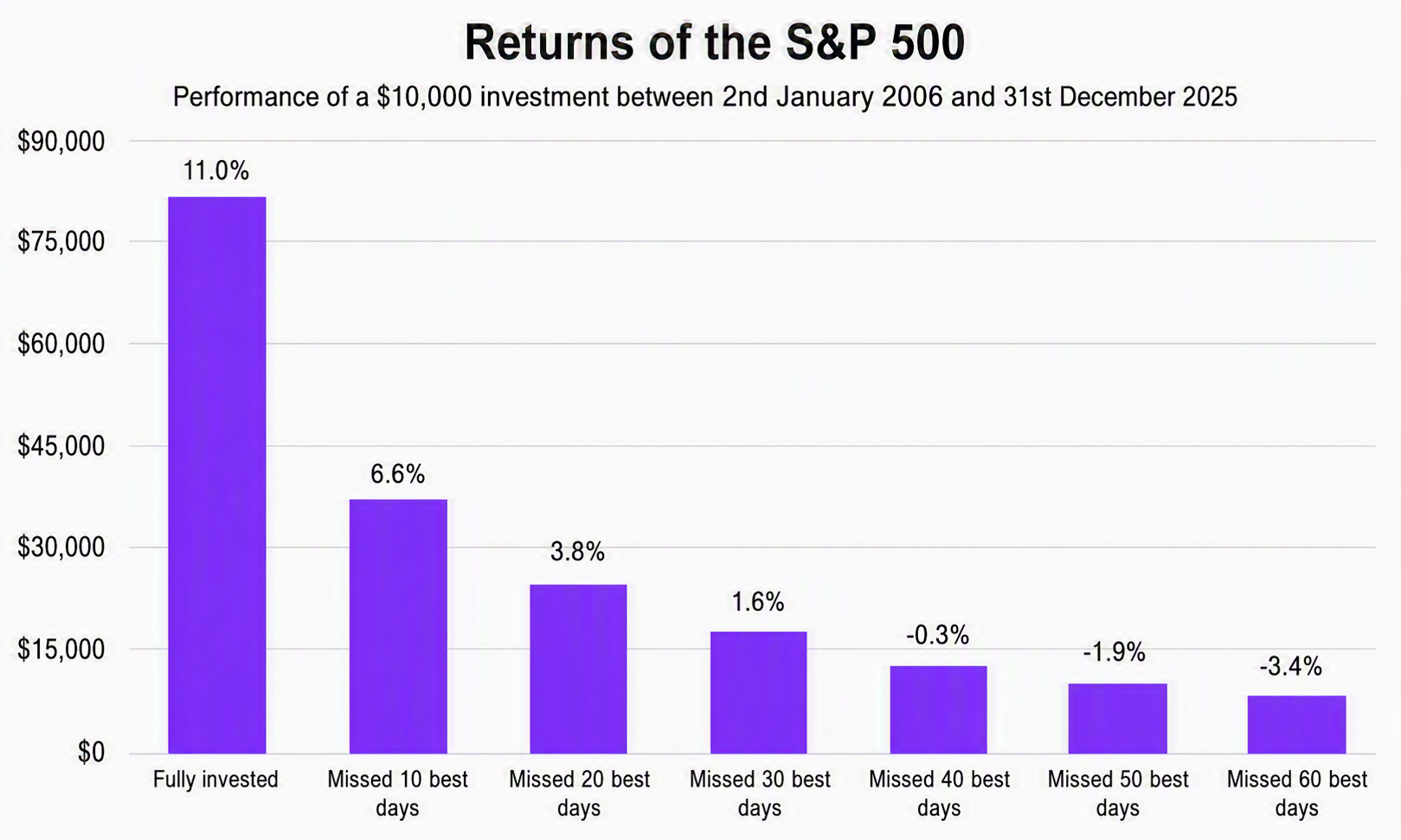
There will always be reasons to wait. Markets have never operated in a risk-free environment, and they never will. So, how do you avoid getting stuck in the scroll? For many investors, discretionary investment management may be the answer. Rather than attempting to digest every headline, forecast and market opinion, clients can delegate those responsibilities to a dedicated investment team whose job is to assess opportunities, monitor risks and make informed decisions on their behalf.
At Titan Wealth, we believe successful investing is not about reacting to every piece of news that appears on a screen. Nor is it about attempting to perfectly predict what markets will do in the short term. Our focus is on building robust portfolios that are aligned with our clients' objectives and capable of delivering attractive long-term outcomes across a variety of market environments.
For many clients, the greatest benefit is not simply the investment expertise; it is the reassurance that their portfolio is being actively managed by professionals whose sole focus is preserving and enhancing capital over the long term.
This can be particularly valuable during periods of heightened market volatility. When markets become unsettled, headlines can become increasingly emotional and opinions more polarised. Investors managing their own portfolios may feel tempted to make reactive decisions driven by short-term events. A disciplined discretionary investment process helps remove much of that emotion and keeps investment decisions anchored to a long-term strategy.
Importantly, discretionary investment management is not about eliminating risk, as risk is an unavoidable part of investing. Instead, it is about understanding, managing and being appropriately compensated for the risks being taken. Through diversification, careful security selection and ongoing portfolio monitoring, we seek to improve the probability of successful long-term outcomes for our clients.
The Netflix analogy is perhaps a simple one, but it highlights an increasingly common challenge. Having more options does not always make decision-making easier. Sometimes it makes it harder.
Just as scrolling through Netflix rarely leads to a better evening, endlessly searching for the perfect investment opportunity can result in missed opportunities and unnecessary frustration. Successful investing is rarely about finding the perfect answer. More often, it is about having a clear process, making sensible decisions and remaining disciplined over time. After all, at some point you need to stop scrolling and press play.